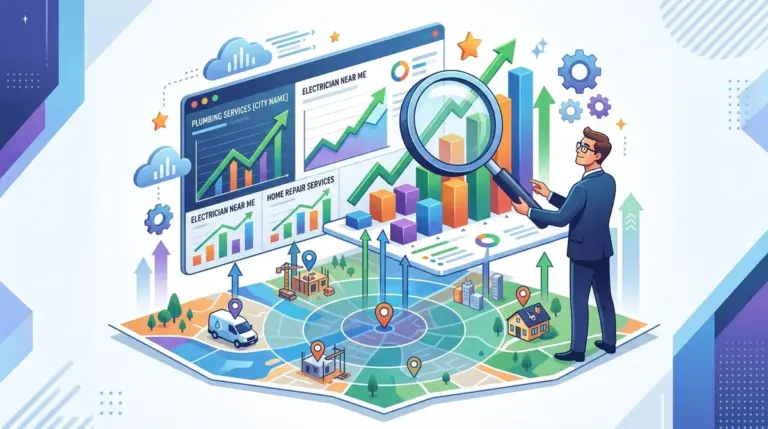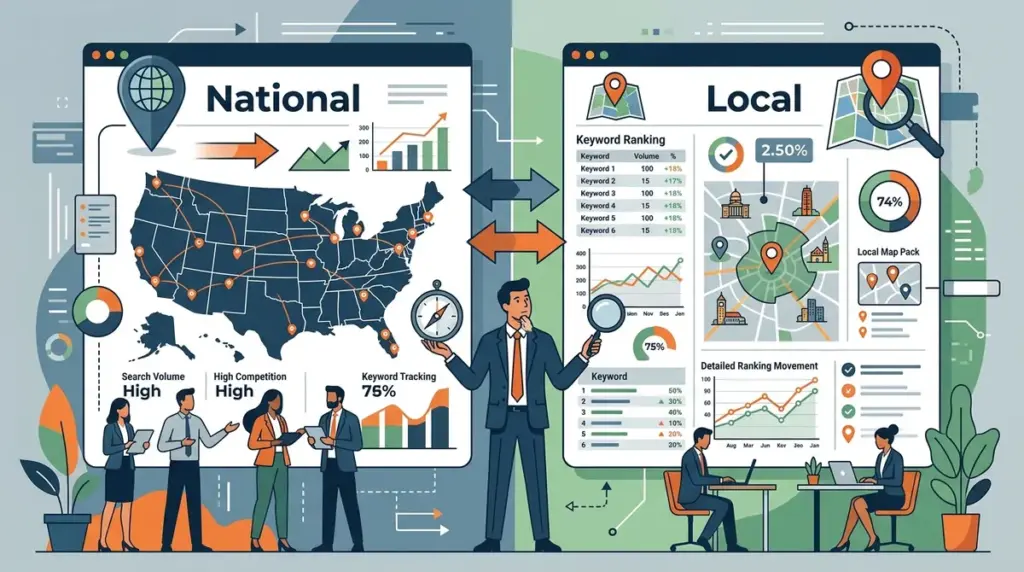
Selecting the wrong tracking scope is one of the most common ways to waste an SEO budget. If you are a SaaS provider tracking keywords at a city level, you are likely over-segmenting data that doesn't vary by geography. Conversely, if you are a multi-location law firm tracking only at the national level, you are blind to the "Map Pack" fluctuations that actually drive your lead volume. The distinction between national and local keyword tracking isn't just about geography; it is about how Google’s algorithm weighs proximity, intent, and competition for a specific query. This is why understanding how to track map pack fluctuations can be vital for certain businesses.
The Mechanics of National Keyword Tracking
National tracking treats the entire country as a single, homogenous market. When you track nationally, you are measuring your site's authority against the "standard" index. This is the default for e-commerce brands, digital publishers, and software companies where the point of sale is location-independent. The goal here is to understand your overall market share and brand visibility across a broad demographic.
Best for: E-commerce stores, affiliate sites, SaaS platforms, and national news outlets.
In national tracking, the SERP features you monitor are typically traditional organic blue links, featured snippets, and "People Also Ask" boxes. Because the results don't shift based on the user's GPS coordinates, the data is more stable but also more competitive. You are competing against every other site in the country, which means your Share of Voice (SoV) metrics become the primary indicator of success. If your SoV is increasing while your average position remains static, you are likely winning on high-volume, high-value head terms.
The Precision of Local Keyword Tracking
Local tracking is hyper-specific, often down to the zip code or even precise latitude and longitude coordinates. This is necessary because Google serves different results for "coffee shop" or "divorce lawyer" depending on whether the user is standing on 5th Avenue or 42nd Street. Local tracking accounts for the "Local Pack" (the map with three business listings) and the localized organic results below it.
Best for: Medical practices, retail chains, home service providers, and franchises.
For these businesses, a national rank of #10 is meaningless if they are #1 in the Local Pack for their specific service area. Local tracking allows you to see how proximity affects your visibility. It also reveals "geo-fencing" trends—where your rankings might drop off sharply once a user moves more than five miles away from your physical location. This data is critical for adjusting your Google Business Profile (GBP) optimization and local backlink strategy.
Warning: Do not rely on "city-name" keyword modifiers (e.g., "plumber London") as a substitute for true local tracking. Modern search intent is driven by "near me" logic where the user omits the city name entirely. To get accurate data, your tracker must spoof the actual GPS location of a device within that specific service area.
Determining Your Tracking Scope: A Decision Framework
Choosing your scope requires an audit of your conversion path. If a customer must physically visit you or if you send a technician to them, local tracking is non-negotiable. If your product is a digital download or shipped via a national carrier, national tracking provides the clearest picture of your ROI.
- Hybrid Businesses: Companies like national retailers with physical storefronts (e.g., Target or Best Buy) must use both. They track national terms for e-commerce performance and local terms to drive foot traffic to specific branches.
- Service Area Businesses (SABs): If you don't have a storefront but serve a specific region (like a roofer), you should track at the local level across multiple "neighborhood" nodes to map your total coverage area.
- Brand vs. Non-Brand: National brands often track their brand name nationally to guard against reputation issues, while tracking service keywords locally to compete with regional players.
Key Metrics for Each Scope
The data points that matter shift significantly depending on the scope you choose. National tracking is a game of volume and authority; local tracking is a game of proximity and relevance.
In National Tracking, focus on:
- Share of Voice (SoV): The percentage of total clicks you own for a keyword set across the entire country.
- Featured Snippet Ownership: These "zero-click" results are usually handled at a national level and are vital for top-of-funnel traffic.
- Keyword Difficulty: A national view provides a more realistic look at how hard it will be to displace established giants like Wikipedia or Amazon.
In Local Tracking, focus on:
- Local Pack Presence: Are you in the top 3 map results? This is often more valuable than the #1 organic spot.
- Average Map Position: Tracking how your map ranking fluctuates across different parts of a city.
- Review Count and Rating: Since these appear directly in the local SERP, they impact your click-through rate (CTR) more than meta descriptions do in a national context.
Managing Multi-Location Complexity
For agencies managing franchises or businesses with 50+ locations, the challenge is data aggregation. You cannot simply look at a single "average" rank. You need to segment your tracking by region or city tier. This allows you to identify if a ranking drop is a systemic issue (a site-wide algorithm penalty) or a local issue (a new competitor in a specific city or a suspended Google Business Profile).
High-density urban areas often require more frequent data refreshes. In a competitive market like New York or Los Angeles, local rankings can shift multiple times a day based on the proximity of the searcher and the time of day (especially for restaurants). National rankings tend to be more "sticky," making weekly or even bi-weekly updates sufficient for many industries.
Building a Dual-Scope Tracking Strategy
To implement a professional tracking setup, start by categorizing your keyword list into "Global Intent" and "Local Intent." Assign your high-level research terms (e.g., "how to fix a leaky pipe") to a national tracking campaign. These drive blog traffic and build your site's overall E-E-A-T. Assign your transactional terms (e.g., "emergency plumber") to local tracking campaigns centered on your specific service zip codes. This detailed approach helps businesses effectively track rankings by zip code for maximum local impact.
This dual approach ensures you aren't overpaying for local tracking credits where they aren't needed, while simultaneously ensuring you aren't missing the granular shifts in the Map Pack that directly impact your bottom line. Periodically review your "near me" keyword performance; if you notice your national organic rank is high but your local map rank is low, it’s a signal to pivot your resources toward local link building and GBP engagement rather than general content production.
Frequently Asked Questions
Should I track mobile and desktop results separately for local SEO?
Yes. Local intent is significantly higher on mobile devices. Google often displays different Map Pack results on mobile based on the user's precise movement, whereas desktop results may rely on the ISP's location or a broader city-center default.
How many locations should I track for a single business?
As a rule of thumb, track at least three points: one at your physical business location and two at the outer edges of your primary service area. This helps you visualize how far your "ranking power" extends before it fades.
Does national tracking include the Map Pack?
Generally, no. National tracking pulls from the standard organic index. If a Map Pack appears in a national search, it is usually a sign that Google has detected "implicit local intent," meaning you should probably be tracking that specific keyword locally instead.
Will tracking too many locations hurt my SEO?
Tracking itself has no impact on your actual rankings; it is purely a measurement tool. However, tracking too many locations can lead to "data noise," making it harder to find actionable insights. Focus on your most profitable areas first.