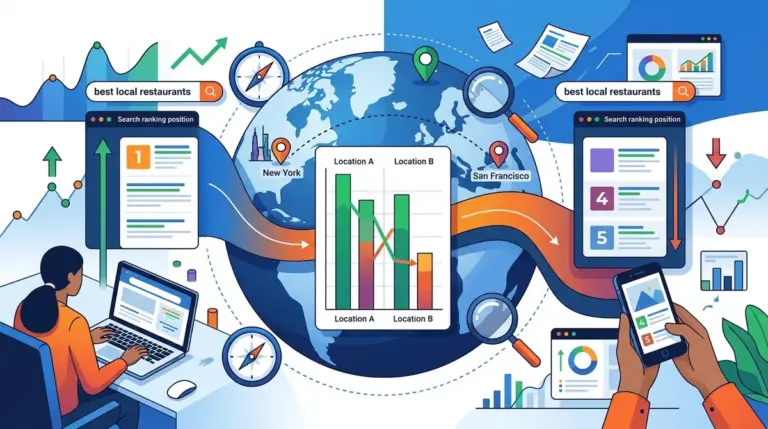
Service Area Businesses (SABs) face a unique attribution problem: their physical address is often hidden or irrelevant to the consumer, yet their visibility depends entirely on hyper-local proximity. For a plumber, an HVAC technician, or a landscaping crew, ranking #1 in a city center is useless if their actual leads come from a cluster of suburbs fifteen miles away. Traditional rank tracking, which often aggregates data at a city-wide level, fails to capture the volatility of the "Local Pack" and the impact of the user's precise location at the moment of search.
To accurately monitor performance for an SAB, you must shift from broad keyword tracking to a coordinate-based strategy. This requires understanding how Google’s proximity filter fluctuates across a service territory and how to isolate organic rankings from Map Pack visibility.
Defining the SAB Tracking Perimeter
The primary challenge for an SAB is that Google calculates proximity based on the "centroid" of a search. For a storefront, the centroid is the shop’s physical location. For an SAB, the centroid is typically the center of the service area defined in the Google Business Profile (GBP), or more often, the user’s current GPS coordinates. Because rankings can drop off sharply just a few blocks away from a service hub, tracking a single "city" location provides a distorted view of reality.
Best for: Multi-location service providers and local contractors who need to justify marketing spend across specific high-value zip codes.
Effective tracking requires setting up "geo-coordinates" rather than just city names. By using specific latitude and longitude points, you can simulate searches from the exact neighborhoods where the highest-value contracts are located. If a roofing company serves a 30-mile radius, the tracking strategy should include at least five to ten distinct data points to map out the "rank decay" that occurs as distance from the business base increases.
Local Pack vs. Organic SERP Dynamics
SABs live and die by the Local Pack (the map block at the top of the SERP). However, the factors that drive Local Pack rankings—proximity, GBP optimization, and review velocity—are distinct from the factors driving the "blue link" organic results below them. You must track these as two separate datasets.
The Role of Proximity and the Centroid
Google’s "Possum" update and subsequent proximity adjustments mean that if two competitors are located close to each other, Google may filter one out of the Local Pack to provide variety. For an SAB with a hidden address, this filtering is even more aggressive. Tracking must account for this by monitoring "Share of Voice" within the Map Pack across multiple points in the service area. If you only track from one fixed point, you might miss the fact that you are being filtered out in the neighboring town due to a competitor’s closer proximity to that specific sub-centroid.
Technical Setup for Accurate SAB Monitoring
To get clean data, your rank tracker must support localized IP overrides or GPS coordinate simulation. Standard browser-based tracking is insufficient because it relies on the data center's location rather than the consumer's doorstep.
- Grid-Based Tracking: Instead of a single point, use a grid (e.g., 3x3 or 5x5 miles) to see how your ranking "heat map" looks. This reveals exactly where your visibility hits a wall.
- Mobile vs. Desktop Parity: SAB searches are heavily skewed toward mobile devices, often with "near me" intent. Ensure your tracking mimics mobile crawlers to capture the specific layout of mobile-only call buttons and map expansions.
- Language and Locale: For businesses in multilingual areas, track keywords in both primary and secondary languages (e.g., "Plumber" vs "Plomero") to capture the full breadth of the local market.
Warning: Do not rely on "City, State" settings in generic tracking tools. These settings usually default to the geographic center of a city (often a city hall or downtown core), which may not represent where your actual customers live or where your service radius is most competitive.
Keyword Strategy for Service-Based Visibility
SAB keyword research should be categorized by intent and geography. You are not just tracking "emergency furnace repair"; you are tracking how that term performs when appended with specific neighborhood names or "near me" modifiers.
Implicit vs. Explicit Keywords: An "explicit" keyword includes the location (e.g., "pest control Austin"). An "implicit" keyword relies on the user's location (e.g., "pest control"). For an SAB, implicit keywords are harder to track but more valuable, as they trigger the Local Pack based on the user's immediate vicinity. Your tracking tool must be able to simulate these "near me" searches by injecting precise geo-parameters into the search query without adding the location name to the text string.
Tracking Competitor Intrusion
In the SAB space, "lead generation" sites (like Angi or Yelp) often dominate organic results, while local independents dominate the Map Pack. You need to monitor which "aggregator" sites are outranking your organic landing pages. If a specific neighborhood is dominated by Yelp in the organic spots, your strategy should shift toward optimizing your Yelp profile for that area rather than trying to force a thin local landing page into the top three.
Measuring Performance Beyond the Map
Rankings are a leading indicator, but for SABs, the disconnect between "ranking" and "revenue" is often caused by the "Google Screened" or "Local Services Ads" (LSA) units. These paid units sit above the Map Pack and can push organic results so far down the page that even a #1 ranking sees a decline in CTR.
Advanced tracking should include "SERP Feature" monitoring. If an LSA unit appears for your primary keywords, your organic rank tracking must reflect that your "real estate" on the screen has diminished, even if your numerical rank remains the same. This context allows you to adjust bidding strategies or pivot content to target "long-tail" queries where LSAs are less prevalent.
Actionable Data Integration
To turn these rankings into a commercial advantage, integrate your rank data with Google Business Profile Insights. If your rankings are high in a specific zip code but "Direction Requests" or "Phone Calls" are low, there is a conversion bottleneck. It may be that your review star rating is lower than the competitors appearing alongside you in that specific grid point, or your GBP "Service Area" settings are not aligned with where you are actually ranking.
Stop viewing rank tracking as a static list of numbers. For a Service Area Business, it is a dynamic map of market share. By deploying coordinate-based monitoring and distinguishing between Map Pack and organic performance, you can identify exactly where your brand disappears and take surgical action to reclaim those neighborhoods.
Frequently Asked Questions
How often should I track rankings for an SAB?
Weekly tracking is usually sufficient for most contractors, but daily tracking is recommended during peak seasons (e.g., AC repair in July) or immediately after a GBP update to catch volatility early.
Why does my business rank well in one neighborhood but disappear in the next?
This is typically due to the "Proximity Filter." Google prioritizes businesses with a physical proximity to the searcher. If a competitor has a verified address (even if hidden) closer to that neighborhood, they will often displace you in the Local Pack.
Should I track "near me" keywords separately?
Yes. "Near me" queries rely heavily on real-time GPS data. Tracking these requires a tool that can simulate a specific location's latitude and longitude to see what a user on a mobile device would actually see at that street corner.
Does my hidden address affect my ability to track rankings?
It does not affect the tracking process itself, but it does affect your ranking potential. Google still knows your verification address; it just doesn't show it to users. Your rankings will generally be strongest around your verification point, even if your service area is set much wider.