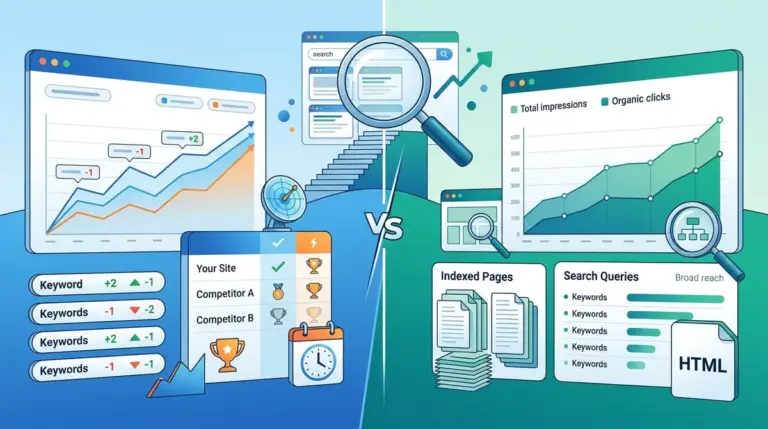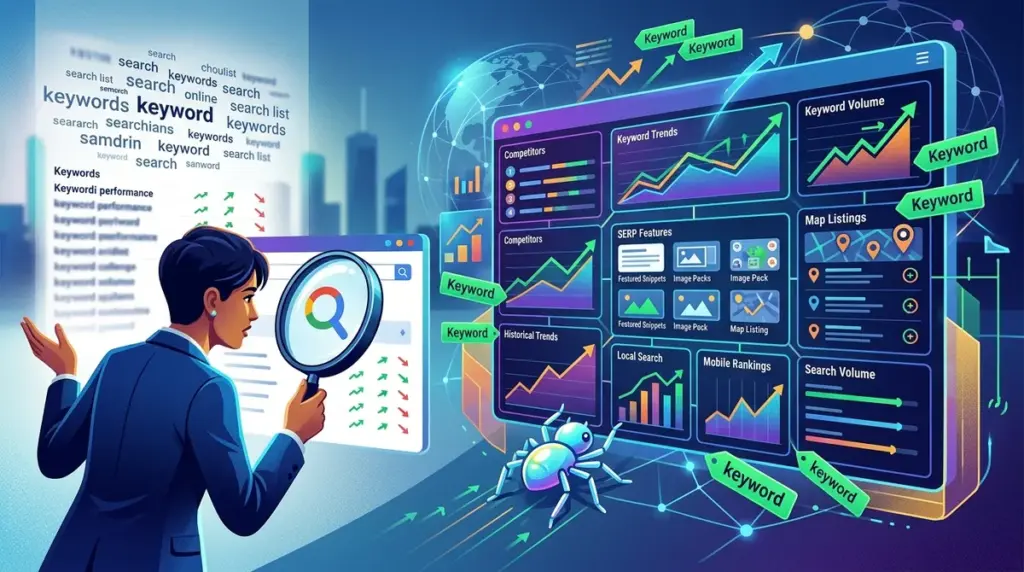
Google Search Console (GSC) is the definitive source for understanding how Google indexes a website, but relying on it as a primary rank tracking tool creates significant blind spots for performance-driven SEO teams. While GSC provides first-party data directly from the source, its architecture is built for diagnostic health and broad performance trends rather than the granular, real-time competitive intelligence required to win high-value SERPs. For agencies and enterprise SEOs, the gap between "average position" and "actual ranking" is where ROI is often lost.
The Latency Problem and Real-Time Decision Making
The most immediate friction point with Search Console is data latency. GSC typically operates on a 48-to-72-hour delay. During a core algorithm update or a major site migration, a two-day information vacuum is unacceptable. SEO teams need to see the immediate impact of technical changes or content refreshes to pivot strategies before traffic drops become catastrophic. Dedicated rank trackers provide on-demand updates, allowing users to refresh keyword sets and see shifts within minutes, not days.
Best for: Managing site migrations, monitoring high-stakes product launches, and responding to sudden algorithm volatility.
The Flaw of Average Position in Dynamic SERPs
Search Console reports on "Average Position," a metric that can be deeply misleading. This figure is calculated by averaging the highest ranking of your site for a specific query across all impressions. If your site ranks #1 for a user in New York but #10 for a user in Los Angeles, GSC might report an average of #5.5. This tells you nothing about your actual visibility in specific markets.
Why Averages Mask Volatility
Averages smooth out the peaks and valleys of keyword performance. A keyword might bounce between position #2 and #40 due to SERP testing by Google, but GSC will report a stable-looking average in the middle. This prevents SEOs from identifying "flicker" in the SERPs—a key indicator that a page lacks sufficient authority or relevance for a specific intent. Dedicated trackers record the exact rank at a specific point in time, providing a clear historical timeline of performance rather than a blended mathematical mean.
Data Masking and the Anonymized Query Void
Privacy regulations and Google’s own data-handling policies mean that a significant portion of search data is hidden under the "Anonymized Queries" label. For sites with high-volume, long-tail traffic, this can account for up to 50% of total clicks and impressions. You cannot optimize for what you cannot see. Third-party rank monitoring tools bypass this by tracking specific keyword lists regardless of whether Google chooses to show that data in your Search Console dashboard. This ensures that long-tail strategies are measurable and verifiable.
Warning: Relying solely on GSC for keyword discovery often results in a "survivorship bias" where you only optimize for terms you already rank for, completely missing high-opportunity keywords where your site currently has zero visibility.
Competitive Intelligence: The Blind Spot of First-Party Tools
Search Console is a closed loop; it only shows your data. In a competitive landscape, knowing you dropped from position #3 to #8 is only half the story. You need to know who replaced you. Did a direct competitor launch a better guide? Did a government site take the snippet? Is a video carousel pushing organic results down the page?
- Share of Voice (SoV): Measuring your brand's visibility against specific competitors across a keyword bucket.
- Competitor Movement: Identifying which specific URLs are gaining ground when you lose it.
- SERP Feature Ownership: Tracking which competitors are winning Featured Snippets, Local Packs, or Image carousels.
Without this context, SEO remains reactive. Dedicated rank tracking allows teams to perform "gap analysis," identifying where competitors are vulnerable and where your own content needs defensive updates.
Granular Local Tracking vs. Country-Level Aggregation
For businesses with a physical footprint or regional service areas, GSC’s country-level data is too broad to be actionable. A plumber in Chicago does not care about their average rank in the United States; they care about their rank in specific zip codes or neighborhoods. Search Console does not provide the coordinate-level granularity required for local SEO. Specialized trackers simulate searches from specific IP addresses and locations, providing a true "boots on the ground" view of the local SERP, including Local Pack rankings which are often omitted or poorly represented in GSC performance reports.
Identifying and Capturing SERP Features
Modern search results are no longer a "ten blue links" environment. The presence of "People Also Ask" (PAA) boxes, Featured Snippets, and AI Overviews significantly alters click-through rates (CTR). While GSC tracks impressions, it does not distinguish between a standard organic link and a Featured Snippet in its primary reporting interface. Dedicated tools provide specific icons and filters for SERP features, allowing SEOs to:
1. Identify keywords where a Featured Snippet is available but not owned by the brand.
2. Track the "pixel height" of results to understand how far down the page the first organic result actually appears.
3. Monitor the stability of PAA inclusions to refine FAQ content strategies.
Building a Robust Rank Intelligence Stack
To move beyond basic monitoring, SEO teams should use Search Console for what it does best—identifying technical crawl issues and seeing which queries are currently driving clicks—while using a dedicated rank tracker for strategic planning. This hybrid approach ensures that you have the "why" (GSC) and the "where" (Rank Tracker). By integrating these data sets, agencies can provide clients with reports that show not just that traffic increased, but that the brand successfully captured 15% more Share of Voice in a high-priority category over a three-month period.
Frequently Asked Questions
Does Search Console track all keywords?
No. Google Search Console only tracks keywords that have generated impressions for your site. It does not track keywords where you have no visibility, nor does it provide data on anonymized queries that fall below a certain privacy threshold.
Why is there a discrepancy between GSC and my rank tracker?
GSC reports an average of all impressions over a period, whereas rank trackers usually report a "snapshot" of a specific location at a specific time. Discrepancies are expected due to personalization, localization, and GSC's data-averaging methodology.
Can I see competitor rankings in Search Console?
No. Search Console is strictly for your own domain's performance. To see where competitors rank or to perform a keyword gap analysis, you must use a third-party rank monitoring tool.
Is "Average Position" a reliable KPI?
Average position is a directional metric at best. It is highly susceptible to outliers—for example, if you rank #1 for a high-volume term but #80 for a low-volume term, your average may look poor despite high traffic. Tracking "Rank Distribution" (how many keywords are in positions 1-3 vs. 4-10) is a much more effective KPI.