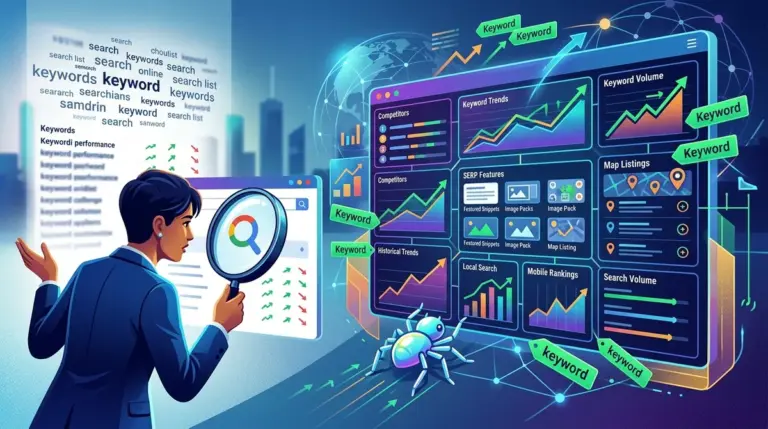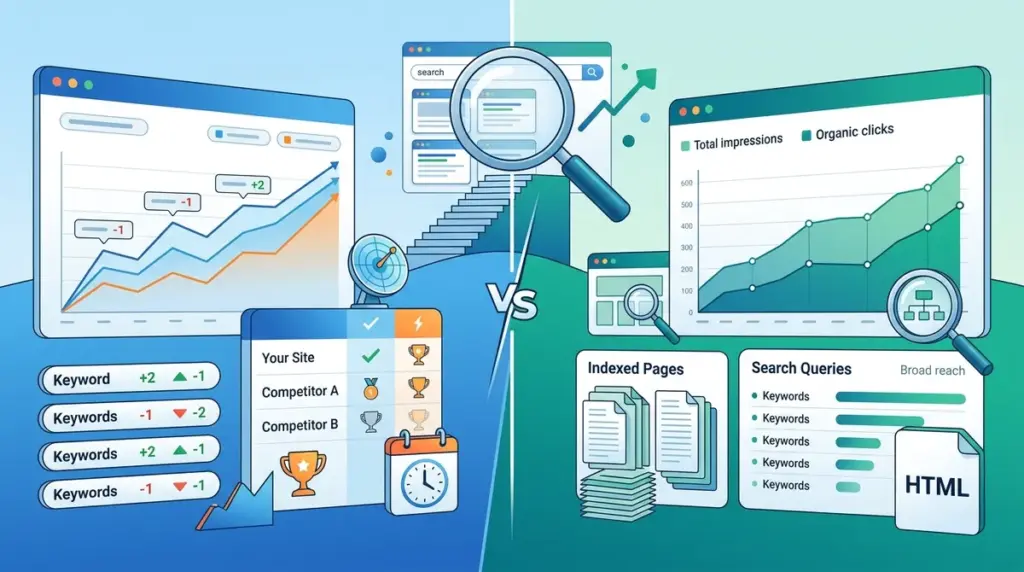
Google Search Console (GSC) and dedicated rank trackers are often treated as interchangeable, but they serve fundamentally different functions in an SEO stack. GSC is a retrospective diagnostic tool that reports on how Google’s servers recorded user behavior. A rank tracker is a proactive competitive intelligence tool that simulates specific user environments to capture the state of the search engine results page (SERP) in real-time. Choosing between them isn't about finding the "better" tool; it is about understanding that GSC tells you what happened in the past, while a rank tracker tells you what is happening right now and why your competitors are winning.
The Latency Factor and Data Freshness
Google Search Console operates on a significant delay, typically ranging from 16 to 48 hours. This lag makes it impossible to use GSC for monitoring the immediate impact of a site migration, a major content update, or a sudden algorithm shift. If a core update rolls out on a Tuesday morning, GSC data won't reflect the damage or gains until Thursday at the earliest.
Rank trackers bypass this delay by querying the SERP directly. Most professional-grade trackers allow for on-demand updates or daily refreshes, providing a live snapshot of current positions. For news publishers or e-commerce sites running time-sensitive campaigns, the ability to see a ranking shift within minutes of a deployment is the difference between a quick fix and two days of lost revenue.
Best for: Immediate feedback loops and technical troubleshooting during site changes.
Anonymization vs. Total Keyword Visibility
One of the most significant limitations of Search Console is the "anonymized queries" filter. To protect user privacy, Google omits data for keywords that are searched infrequently or contain personally identifiable information. For niche sites or B2B companies targeting long-tail queries, this can result in 30% to 50% of actual click data being hidden under a "hidden" or "other" category.
A rank tracker does not rely on Google’s filtered reporting. It tracks any keyword you input, regardless of search volume or privacy constraints. This allows SEOs to monitor the specific, low-volume, high-intent keywords that often drive the highest conversion rates but remain invisible in GSC’s performance reports.
Geographic Granularity and Local Search Precision
Google Search Console provides data primarily at the country level. While it can show you that you rank in the United States, it cannot effectively differentiate between a user searching for "plumber" in Chicago versus one in Los Angeles. For local businesses or national brands with local footprints, this lack of granularity is a major blind spot.
Rank trackers allow for precise geo-targeting, often down to the city, neighborhood, or even specific zip code. This is critical because SERPs are now hyper-localized. A rank tracker can simulate a mobile user standing on a specific street corner to see if a business appears in the Local Pack (the "Map Pack"), whereas GSC will simply aggregate those impressions into a national average.
Pro Tip: Always compare GSC’s "Average Position" with a tracker’s "Rank." GSC averages your position across every single impression, including those from image search or deep paginated results, which often drags your "average" down and obscures your true visibility for head terms.
Visual SERP Features and Share of Voice
GSC is a text-heavy reporting environment. It tells you your position, but it doesn't tell you what the SERP actually looks like. Modern SEO is no longer just about the "blue link" positions 1 through 10. It is about winning Featured Snippets, People Also Ask (PAA) boxes, Video Carousels, and Local Packs.
Rank trackers provide a visual or categorical breakdown of these features. They can alert you when:
- A competitor has "stolen" your Featured Snippet.
- A new "People Also Ask" box has pushed your #1 organic result below the fold.
- Your YouTube videos are appearing in the video carousel for a specific query.
- A "highly visual" SERP layout is reducing the overall CTR of organic results.
By quantifying "Share of Voice," rank trackers help you understand the actual "pixels" you own on the screen, rather than just a numerical rank that may be buried under three rows of ads and a map.
Competitive Intelligence and Market Benchmarking
Perhaps the most distinct difference is that Search Console only provides data for the domains you own. It offers zero visibility into what your competitors are doing. You can see your clicks dropping, but GSC won't tell you that a specific competitor just launched a content hub that is cannibalizing your traffic.
A rank tracker is built for competitive analysis. You can add competitor domains to your tracking sets to monitor their movements in tandem with yours. This allows for:
- Direct Comparison: Seeing exactly which keywords a competitor is outranking you on.
- Market Shift Detection: Identifying if a drop in your rank is a site-specific issue or a broader market trend where all players lost ground to a new entrant like Amazon or Wikipedia.
- Gap Analysis: Discovering keywords where multiple competitors rank in the top 10, but you are nowhere to be found.
Integrating Both Data Sources for Maximum Impact
To manage a professional SEO campaign, you must use both tools in a complementary workflow. GSC is the "Source of Truth" for traffic and technical health. It tells you which pages Google has indexed and exactly how many people clicked. It is the only place to find manual penalties and core web vitals data directly from the source.
The rank tracker is your "Strategic Compass." It tells you where the opportunities are, how the competitive landscape is shifting, and how to optimize for specific SERP features that GSC ignores. Use GSC to find "striking distance" keywords (those ranking in positions 11-15) and then move those keywords into your rank tracker for daily monitoring and aggressive optimization.
Common Questions About Search Data
Why does GSC show a different rank than my tracker?
GSC calculates an average position based on every time your site appeared in a search result for a user. This includes personalized results and different geographic locations. A rank tracker uses a "clean" browser environment from a fixed location to provide a standardized, objective rank that isn't skewed by an individual's search history.
Can I replace a rank tracker with GSC to save money?
Only if you do not care about local SEO, competitor movements, or real-time data. For small, static sites, GSC might suffice. For any business where SEO contributes to revenue, the lack of competitor data and the 48-hour delay in GSC makes it a poor substitute for a dedicated tracker.
Does tracking keywords too often hurt my SEO?
No. Rank trackers query Google through various methods (like APIs or localized proxies) that do not affect your site's performance or your relationship with Google. Tracking keywords is a standard industry practice and has no impact on your actual rankings.
Which tool is better for reporting to clients?
Agencies typically use rank trackers for client reporting because they offer "Share of Voice" and "Visibility Index" metrics which are easier for stakeholders to understand than the raw, often confusing "Average Position" metric found in Search Console.