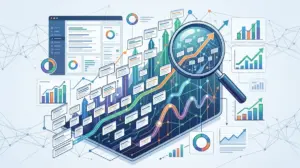
A Top 100 rank tracker shows where your site appears across the first 100 organic results for each keyword, then records movement over time so you can spot gains, losses, volatility, and competitor takeovers before they affect traffic. Unlike basic position checkers that only report whether you are on page one, a Top 100 tracker gives full search visibility across pages 1-10, which is essential for keywords that are close to breaking through, slipping downward, or being challenged by stronger domains.
What a Top 100 rank tracker actually measures
For each tracked keyword, the tool checks the search engine results and captures your ranking position anywhere from 1 to 100. It also identifies which URL is ranking, whether a different page replaced the expected landing page, and which competitors occupy nearby positions. In a practical SEO workflow, this means you can see whether a keyword moved from 14 to 9, 9 to 18, or 43 to 27, and connect that change to content updates, internal linking, technical fixes, or competitor activity.
Search Engine Rank Tracker is built for this kind of monitoring. It helps teams track ranking changes at scale, compare keyword groups, review search visibility trends, and produce reports that explain what changed and why it matters. That is especially useful when rankings fluctuate outside the top 10, where many opportunities and risks are otherwise missed.
When to use a Top 100 rank tracker
Use a Top 100 rank tracker when rankings beyond page one still matter to revenue, lead generation, editorial growth, or campaign measurement. This is common in competitive markets where new pages often enter around positions 20-60 before climbing, and where established pages can decline gradually before traffic drops become obvious in analytics.
Best-fit use cases
Agencies use it to prove progress on difficult keywords that have not yet reached the top 10 but are steadily improving. In-house SEO teams use it to monitor category pages, product collections, service pages, and editorial hubs across large keyword sets. Publishers use it to track article clusters and identify when one story starts outranking another. Businesses use it to watch local, national, and non-brand terms without losing sight of emerging competitors.
Why Top 100 data is commercially useful
Rankings between positions 11 and 100 are where much of the decision-making happens. If a priority keyword rises from 31 to 15, that is a meaningful signal that the page is gaining relevance and may deserve further optimization. If a term falls from 12 to 24, the page may be losing authority, freshness, or SERP appeal. If a competitor enters at 19 across multiple related terms, that may indicate a new content strategy, stronger internal linking, or a successful category expansion.
Practical benefits of tracking the top 100 results
- Find keywords that are close to page-one entry and worth immediate optimization
- Catch ranking declines early, before traffic loss becomes severe
- See which URL is ranking and detect cannibalization fast
- Monitor competitor gains across the same keyword set
- Report progress clearly, even when wins happen outside the top 10 first
What to look for in a Top 100 rank tracker
Daily or scheduled ranking updates
Frequent updates matter because ranking changes are often gradual, then sudden. A reliable tracker should let you review daily movement for high-priority keywords and maintain historical records so you can compare week-over-week and month-over-month visibility.
Keyword grouping and tagging
Top 100 data becomes much more useful when keywords are grouped by intent, topic, location, page type, or campaign. This allows you to see whether service terms are improving while blog terms are declining, or whether one product category is outperforming another.
Competitor tracking in the same result set
A strong tracker should not only report your own position but also show who moved above or below you. That makes competitor analysis actionable rather than abstract. You can identify which domains gained share, which pages replaced yours, and where new SERP entrants are changing the landscape.
Landing page visibility and cannibalization checks
If the wrong page ranks for a keyword, or if ranking URLs keep changing, performance can become unstable. Top 100 tracking should highlight URL swaps so you can fix internal linking, consolidate content, or strengthen the intended page.
Reporting clarity
Reporting should make ranking movement easy to explain to clients, stakeholders, and editorial teams. Search Engine Rank Tracker focuses on reporting clarity by showing position changes, keyword trends, visibility patterns, and competitor movement in a format that supports decisions instead of just exporting raw numbers.
How SEO teams use Top 100 tracking to make decisions
Prioritizing near-win keywords
Keywords in positions 11-20 are often the best optimization targets because they are already close to stronger click potential. Teams can improve titles, refresh copy, expand supporting sections, adjust internal links, and strengthen schema or on-page relevance to push those terms upward.
Diagnosing drops before traffic reports catch up
When a keyword falls from 8 to 16, traffic may not collapse instantly, especially if seasonality or branded demand masks the issue. Top 100 tracking exposes that movement early. This gives teams time to review competitors, inspect content freshness, and assess technical changes.
Measuring content rollout impact
New pages often appear in the top 100 long before they become meaningful traffic drivers. Tracking positions 1-100 helps you measure whether a launch is gaining traction, stagnating, or being outranked by stronger competitors. That is much more useful than waiting until a page either reaches page one or disappears from the conversation.
Short workflow example
An agency launches optimization work for a software category page and tracks 60 related keywords in Search Engine Rank Tracker. In week one, 18 keywords rank between 21 and 50. By week four, 11 of those terms move into positions 11-20, while two competitors gain visibility on comparison keywords. The team updates internal links, expands comparison content, and refines title tags. In the next reporting cycle, five keywords enter the top 10 and the client can see a clear path from ranking movement to optimization actions.
How Search Engine Rank Tracker supports Top 100 monitoring
Search Engine Rank Tracker is designed for SEO professionals and reporting-heavy workflows that need more than a simple rank lookup. It helps you monitor broad keyword sets, review ranking changes across the full top 100, compare visibility by segment, and keep competitor movement in view. For agencies, that means clearer client reporting. For in-house teams, it means better prioritization. For publishers and businesses, it means a more complete picture of search performance beyond page-one snapshots.
FAQ
Why track the top 100 instead of just the top 10?
Because many important ranking changes happen before a keyword reaches page one or after it slips off it. Top 100 tracking shows progress, decline, and opportunity much earlier.
Who should use a Top 100 rank tracker?
SEO agencies, in-house teams, publishers, ecommerce businesses, and service companies that need to monitor keyword movement, search visibility, and competitor changes across meaningful keyword sets.
Can Top 100 tracking help with competitor analysis?
Yes. It shows which competitors enter, rise, or displace your pages for the same keywords, making it easier to react with content, linking, and optimization updates.
Is Top 100 data useful for reporting?
Yes. It gives stakeholders a clearer picture of momentum, especially when keywords are improving from lower positions before traffic gains fully materialize.