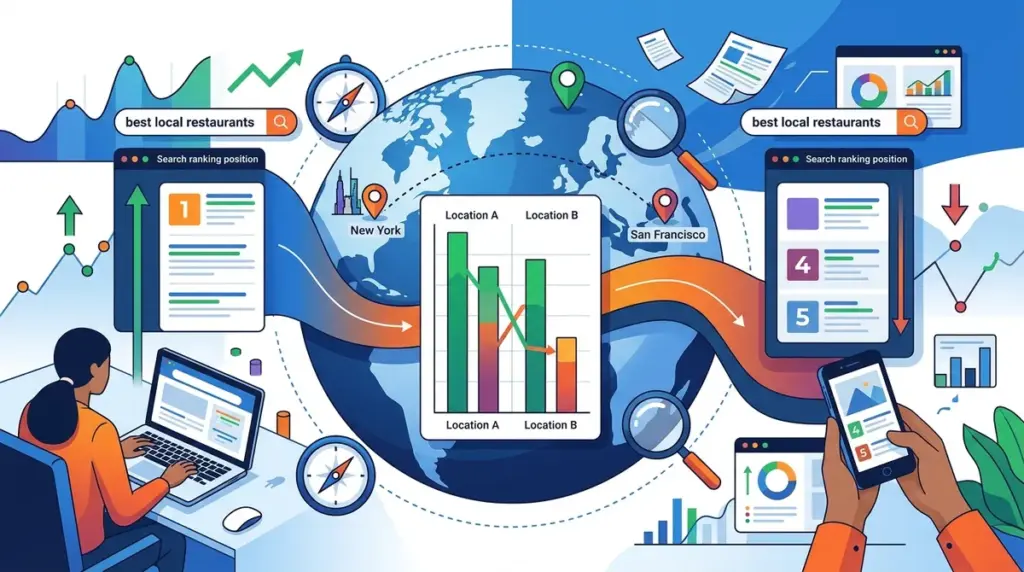
SEO professionals frequently face a specific, frustrating scenario: a rank tracking report shows a keyword in position three, but the client, searching from their office, sees it on page two. This discrepancy is rarely a bug in the software. Instead, it is the result of Google’s hyper-local algorithmic layers. For any query with even a hint of local intent, the search engine prioritizes proximity, IP data, and device-specific coordinates to serve the most relevant result for that exact square meter.
Understanding how location affects ranking positions is no longer just for "mom and pop" shops. It is a critical requirement for national brands, e-commerce giants, and multi-location service providers. If you are tracking rankings from a single data center in Virginia while your customers are in Los Angeles, your data is fundamentally skewed.
The Mechanics of Location-Based SERP Customization
Google determines a user's location through several data streams, each carrying a different weight depending on the device and the search query. When a user performs a search, the engine checks for:
- IP Address: This provides a general geographic area, usually at the city or neighborhood level, but can be masked or shifted by VPNs and corporate networks.
- GPS Coordinates: Primarily used on mobile devices, this is the most precise signal, allowing Google to serve results based on where a user is standing.
- Search History and Labeled Places: If a user has "Home" or "Work" set in Google Maps, or frequently searches for services in a specific suburb, Google will bias results toward those locations.
- Implicit vs. Explicit Keywords: An explicit search like "pizza Chicago" forces a location regardless of the user's current spot. An implicit search like "pizza near me" or just "pizza" relies entirely on the user’s real-time coordinates.
The "Near Me" phenomenon has evolved. Google now assumes local intent for thousands of keywords that previously triggered national results. For example, searching for "commercial insurance" in New York will yield different organic listings than the same search in Dallas, as Google prioritizes firms licensed or physically present in those specific states.
The Proximity Bias in the Local Pack vs. Organic Results
It is vital to distinguish between the Local Pack (the Map 3-pack) and the localized organic results below it. The Local Pack is hypersensitive to proximity. If a user moves three blocks down the street, the order of the 3-pack can shift entirely. Organic results are slightly more stable but still fluctuate based on the city or region. A law firm might rank #1 organically across an entire state but only appear in the Local Pack for users within a five-mile radius of their physical office.
Warning: Never rely on "incognito mode" as a proxy for localized testing. While it strips away some personalization, Google still uses your IP address to determine your location. To see what a user in a different city sees, you must use tools that allow for specific latitude and longitude overrides.
Why Your Reporting May Conflict with Reality
When a rank tracker reports a position, it typically uses a specific "point of presence." If your tracker is configured to check rankings at a national level, it aggregates data or uses a neutral location. However, searchers are never "neutral."
Best for: Agencies managing multi-location franchises should track rankings at the zip code level rather than the city level to capture the "Map Pack" volatility that impacts actual foot traffic.
The variance in ranking positions often stems from the "Venice" update, an old but foundational part of Google's algorithm that integrated local data into organic search. Because of this, two users in the same city might see different results if one is in the business district and the other is in the suburbs. This makes "average position" a dangerous metric if not contextualized by geography.
Factors That Distort Local Ranking Visibility
Beyond the physical location of the user, several technical factors can change which ranking position is displayed:
Device Type and Mobile-First Indexing
Mobile searches are more likely to trigger the Local Pack. Because mobile users are often on the move, Google places a higher premium on "open now" status and physical distance. A desktop user, conversely, might see more long-form informational content or national directories because Google assumes they are in a "research" phase rather than a "transactional" phase.
The Role of Wi-Fi vs. Cellular Data
A user on a Wi-Fi connection provides a more stable location signal to Google than a user on a cellular tower, which might bounce their IP address to a different city. This is why a client checking their rankings on their phone while commuting might see vastly different results than when they are connected to their office Wi-Fi.
Auditing Rankings Across Multiple Jurisdictions
To get a true picture of performance, you must simulate searches from specific locations. This is not just about seeing if you are "winning" in a specific city; it is about identifying "blind spots" where competitors are out-positioning you in high-value neighborhoods.
Strategic auditing requires setting up tracking for the same keyword across multiple locations. If you are a national service provider, you should be tracking your core keywords in at least your top 10 revenue-generating markets. This allows you to see if a recent algorithm update hit you everywhere or if you are specifically losing ground in regions with high local competition.
Refining Your Localized Reporting Strategy
To provide value to stakeholders, you must move away from the idea of a single "ranking." Instead, adopt a regional or city-based reporting model. Start by identifying the geographic areas that drive the most conversions in your analytics. Focus your tracking efforts there. If a client complains about a ranking drop, check their specific location data before assuming there is a site-wide issue.
Educate your clients on the "Proximity Factor." Explain that Google's goal is to provide the most convenient result for the user, which means a smaller, closer competitor might occasionally outrank a larger, more authoritative brand in specific local pockets. Your job is to dominate the organic space while maintaining a strong enough local presence to capture the Map Pack whenever the user is within a reasonable distance.
Frequently Asked Questions
Does a VPN accurately show local rankings?
Not always. While a VPN can change your IP address to a specific city, Google often recognizes the IP ranges used by VPN providers and may serve "neutral" results or trigger a CAPTCHA. For accurate local tracking, use a tool that specifically overrides the browser's geolocation API or uses the &uule= parameter in the search URL.
Why do I rank #1 in one zip code but #5 in the next one over?
This is usually due to the density of competition and your physical proximity to the center of that zip code. Google’s "centroid" bias means businesses closer to the perceived center of a search area often get a slight ranking boost in local results.
Can I rank locally without a physical office in that location?
You can rank in the organic results (the blue links) by creating location-specific landing pages. However, it is extremely difficult to rank in the Map 3-pack without a verified Google Business Profile and a physical presence in that area, as Google uses these to verify your legitimacy for local users.
How often should I track local rankings?
For high-competition industries like legal, medical, or home services, daily tracking is recommended. Local SERPs are more volatile than national ones because they are influenced by real-time factors like business hours and temporary changes in local search volume.