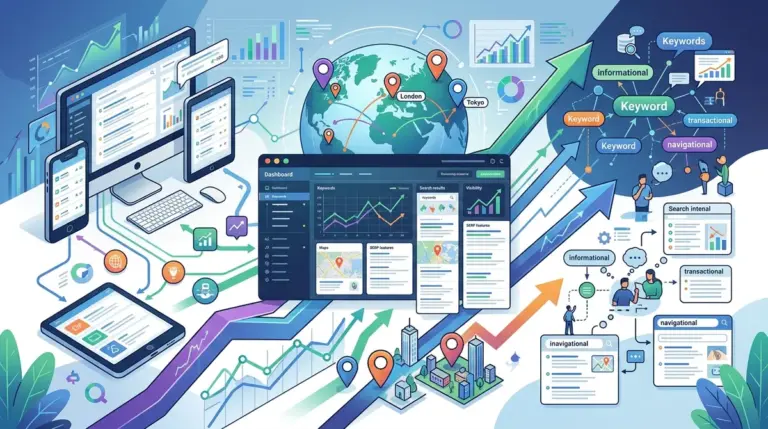
Managing SEO for a single domain is a linear process of monitoring keywords and adjusting content. However, when your portfolio expands to dozens of client sites or a network of niche publishing properties, the complexity scales exponentially. Tracking rankings across multiple domains requires a shift from individual site monitoring to a centralized data architecture that allows for aggregate reporting and cross-domain competitive analysis.
SEO agencies and enterprise marketing teams often struggle with fragmented data. If your ranking data lives in isolated silos, you lose the ability to spot macro-trends, such as algorithmic shifts affecting specific niches or internal keyword cannibalization between two sites you own. To maintain a competitive edge, your tracking setup must prioritize scalability, API efficiency, and granular tagging.
Establishing a Unified Data Architecture
The foundation of multi-domain tracking is how you group your assets. Most professional-grade trackers offer a "Folders" or "Groups" feature. For an agency, grouping by client is the standard. For a portfolio owner, grouping by industry or monetization model (e.g., Affiliate vs. SaaS) provides better strategic insight.
Best for: Large-scale agencies and portfolio managers who need to compare performance across different business units without toggling between separate accounts.
When setting up these groups, ensure you use a consistent naming convention for tags across all domains. If you use the tag "High Intent" on Domain A, use the exact same string on Domain B. This allows you to filter your entire database to see how all your "High Intent" keywords are performing globally, regardless of which domain they belong to.
Utilizing Dynamic Tagging for Portfolio Segmentation
Static tracking is insufficient for large portfolios. Dynamic tagging allows you to automatically categorize keywords based on their ranking position, search volume, or URL structure. For example, you can create a rule that tags any keyword ranking in positions 4-10 as a "Striking Distance" opportunity. When applied across multiple domains, this creates a prioritized "to-do" list for your content team, highlighting exactly which sites are closest to a traffic breakthrough.
Managing Search Intent and Local Nuances Across Regions
Tracking multiple domains often involves managing different geographic markets. A common mistake is tracking all domains against a generic "Global" or "US-wide" index. Google’s results are increasingly localized; a domain ranking #1 in New York might rank #8 in Los Angeles for the same query due to local intent signals.
- Coordinate-level tracking: Set specific zip codes or GPS coordinates for local service businesses within your portfolio.
- Mobile vs. Desktop split: Maintain separate tracking for mobile and desktop for each domain, as the SERP features (like Map Packs or Image Carousels) vary significantly.
- Language-specific tracking: For international portfolios, ensure you are tracking the specific ccTLD or subdirectory (e.g., /es/ or /fr/) against the local version of Google.
Warning: Avoid over-tracking low-volume keywords across multiple domains. If you are tracking 10,000 keywords across 50 domains, your API costs and data noise will skyrocket. Focus your daily tracking on "Money Keywords" and move long-tail research to weekly or monthly refreshes to preserve resources.
Detecting Cross-Domain Keyword Cannibalization
When you own multiple sites in the same niche, you risk competing against yourself. This is common in affiliate marketing where a publisher might own three different review sites targeting the "best CRM software" keyword. If Domain A moves up and Domain B moves down, you haven't gained market share; you've simply shifted it.
To monitor this, use a "Share of Voice" (SoV) metric that aggregates your total visibility across all owned domains for a specific keyword set. If your total SoV is stagnant while individual domains fluctuate, you are likely suffering from internal cannibalization. A centralized rank tracker allows you to see these overlapping rankings in a single view, enabling you to decide which domain should "win" the primary position and which should pivot to a long-tail variation.
Automating Reports for Stakeholders
The primary bottleneck in multi-domain management is reporting. Manually exporting CSVs for 20 different domains is a waste of senior talent. The solution lies in automated data pipelines. Use a tracker that supports direct integration with Looker Studio (formerly Data Studio) or provides a robust API.
Best for: Reporting to C-suite executives or clients who require high-level summaries rather than granular keyword lists.
By pulling data from multiple domains into a single Looker Studio dashboard, you can create a "Master View." This view should display:
1. Total aggregate traffic across the portfolio.
2. Percentage of keywords in the Top 3 across all domains.
3. A "Winners and Losers" table that highlights which specific domain had the biggest volatility in the last 24 hours.
Optimizing API Usage and Refresh Frequencies
Tracking 50+ domains can become expensive if you demand daily refreshes for every single keyword. Professional SEOs optimize their tracking budget by tiering their keywords. Tier 1 keywords (high conversion, high volume) should be tracked daily with instant on-demand updates available. Tier 2 keywords (informational, mid-funnel) can be tracked every three days. Tier 3 keywords (long-tail, low volume) are often sufficient with a weekly refresh.
This tiered approach ensures that your data is fresh where it matters most while keeping your overhead manageable as you add more domains to your portfolio.
Scaling Your Rank Tracking Strategy
To move from reactive monitoring to proactive portfolio management, you must stop treating each domain as an isolated project. Start by auditing your current keyword lists and identifying the "Global" keywords that appear across multiple properties. Centralize these into a master group to monitor your total market influence. Next, automate your tagging rules so that new keywords are categorized the moment they are added. Finally, shift your reporting from "Rankings per Site" to "Performance per Category," which provides a much clearer picture of your ROI across the entire business. Scalability in SEO isn't about doing more work; it's about building systems that handle the volume for you.
Frequently Asked Questions
Can I track different domains in different countries within the same account?
Yes. Most professional tracking systems allow you to assign a specific location and language to each domain or even to individual keywords within a domain. This is essential for international SEO where you might have a .com for the US and a .Search Engine Rank Tracker for the UK.
How do I handle a domain migration while tracking rankings?
When migrating, you should track both the old and new URLs simultaneously. Create a specific tag for the migration period. This allows you to monitor the "hand-off" of rankings in real-time, ensuring that the new domain picks up the visibility lost by the old one without a significant gap.
Is there a limit to how many domains I can track?
Technically, most tools are limited only by your subscription tier or API credits. However, the practical limit is determined by your ability to organize the data. Without a strict tagging and grouping system, managing more than 20 domains becomes a significant manual burden.
Should I track my competitors' domains as well?
Absolutely. Tracking competitor domains alongside your own is the only way to calculate true Share of Voice. By adding competitor domains to your tracking groups, you can see exactly who is gaining ground when you lose it, providing context to ranking drops that might otherwise seem random.