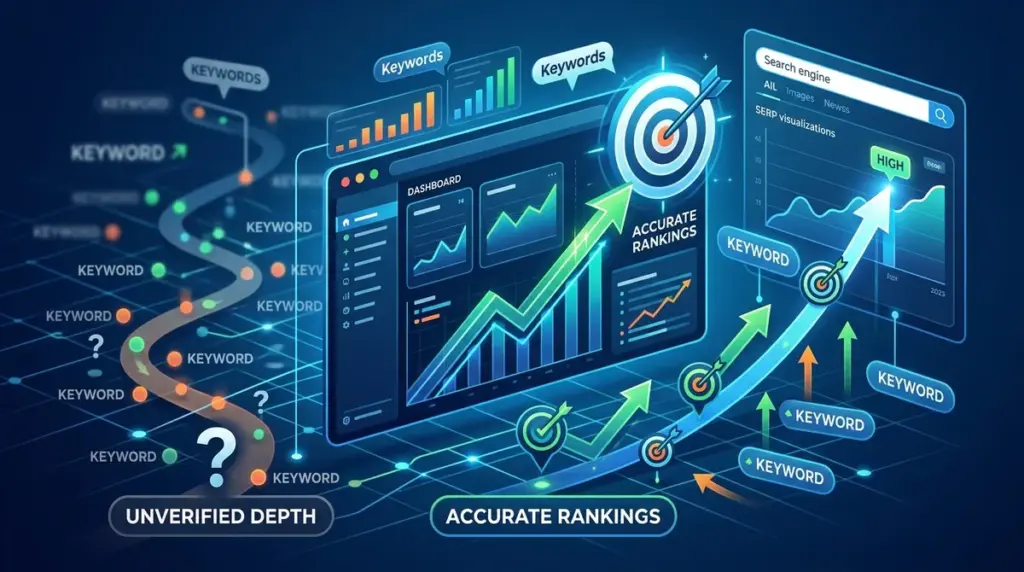
SEO strategy is only as robust as the data feeding it. For enterprise agencies and high-growth publishers, the temptation to track every conceivable long-tail keyword—prioritizing ranking depth—often leads to a dangerous compromise on data integrity. While seeing 50,000 keywords in a dashboard provides a sense of scale, that volume is a liability if the underlying data is cached, stale, or geographically imprecise. If your rank tracker reports a position three for a high-intent commercial term, but a user in Chicago sees a localized map pack pushing you to position seven, your strategy is built on a ghost ranking. Making strategic decisions based on this flawed data means you need to re-evaluate how often you should track rankings.
The Strategic Cost of Inaccurate SERP Data
Inaccurate data does more than just skew monthly reports; it misdirects capital. When an SEO manager sees a supposed "drop" in rankings that isn't actually happening—perhaps due to a tracker hitting a cached result or a different data center—they may trigger unnecessary content refreshes or backlink campaigns. Conversely, missing a real decline because the tracker is using "average" national data instead of localized snapshots allows competitors to capture market share before the error is even noticed.
Impact on Resource Allocation: Every hour spent "fixing" a ranking that hasn't actually moved is an hour stolen from genuine growth initiatives. Accuracy ensures that the technical interventions you perform are responses to market reality, not software glitches.
Misinterpreting Volatility vs. Algorithmic Shifts
High-depth trackers often struggle with "noise." When tracking tens of thousands of keywords across multiple accounts, low-quality tools frequently report massive volatility that is actually just a failure to render modern SERP features like Featured Snippets, People Also Ask (PAA) boxes, or AI Overviews. Distinguishing between a fundamental Google algorithm update and a tracker's inability to parse a complex layout is the difference between a calm, data-driven pivot and a panicked, site-wide overhaul.
Why Ranking Depth Is Often a Vanity Metric
Ranking depth refers to the sheer number of keywords a tool can monitor and how deep into the results (e.g., the top 100 or 500) it goes. While this is useful for broad visibility studies, it is rarely where the revenue is won. For 90% of commercial queries, the only data that matters is what happens in the top 10 positions. If a tool offers "unlimited keywords" but only updates them every three days or uses cheap, non-residential proxies that Google easily identifies and feeds generic results, that depth is functionally useless. This is why understanding the difference between top 10 vs top 100 tracking is so critical for your business.
Precision over Volume: Tracking 1,000 high-value keywords with 99.9% accuracy—verified by zip code and device type—is objectively more valuable than tracking 10,000 keywords with 80% accuracy. The latter creates a margin of error that obscures the actual ROI of your SEO efforts.
Pro Tip: Always verify your tracker’s "last updated" timestamp alongside the specific IP location used for the crawl. If your tracker cannot provide the exact zip code or city-level coordinates used for a localized search, the data should be treated as a directional estimate rather than a hard fact.
Critical Factors Defining True Accuracy
Modern search is no longer a static list of ten blue links. It is a dynamic, fragmented experience that changes based on a dozen variables. To achieve accuracy that actually informs a commercial strategy, a tracker must account for:
- Hyper-Localization: Search results for "insurance broker" in Manhattan are fundamentally different from those in Brooklyn. Accurate tracking requires the ability to specify GPS coordinates or specific zip codes.
- Device Parity: Mobile-first indexing means desktop rankings are often a secondary concern. A tracker must use real mobile user agents to reflect the mobile-specific SERP features that eat into CTR.
- SERP Feature Integration: If you rank #1 but a Featured Snippet and a Local Pack sit above you, your "position 1" is actually "position 3" in terms of visual hierarchy. Accuracy means measuring "pixels from the top," not just numerical rank.
- Data Freshness: In volatile niches like finance or news, 24-hour-old data is already obsolete. On-demand updates are a requirement for accuracy during a site migration or a major core update.
The Scraping Latency Problem
Many budget-tier trackers rely on third-party data aggregators. This creates a "data lag" where the information you see in your dashboard is 12 to 48 hours behind the actual live SERP. In a competitive environment, this latency prevents you from reacting to competitor moves in real-time. High-accuracy tools maintain their own proprietary scraping infrastructure to ensure the data is direct from the source, minimizing the risk of "ghosting" or outdated snapshots.
Auditing Your Current Rank Tracking Reliability
To determine if your current setup favors depth over accuracy, perform a manual audit. Select ten high-competition keywords and check them using a clean browser (incognito, location-spoofed to match your tracker's settings). If the results differ by more than two positions, or if the tracker fails to show the same SERP features you see manually, your data pipeline is compromised.
Key Indicators of High-Quality Data:
1. Visual Confirmation: The tool provides a snapshot or HTML view of the actual SERP it crawled.
2. Search Intent Categorization: The tool recognizes if the SERP has shifted from informational to transactional, which often explains ranking shifts.
3. Consistent Frequency: Data is pulled at the same time every day to account for "day-parting" fluctuations in local results.
Aligning Data Frequency with Business Cycles
The goal of rank tracking is not to collect the most data, but to collect the most actionable data. For an e-commerce site, accuracy during peak shopping hours is paramount. For a local service business, accuracy across specific service areas outweighs the need to track thousands of national-level "how-to" keywords. Shift your focus from "how many keywords can we afford to track" to "how many keywords can we afford to get wrong." When you prioritize accuracy, your SEO reports stop being just a collection of charts and start being a reliable roadmap for revenue growth.
Frequently Asked Questions
Does tracking more keywords decrease data accuracy?
Not inherently, but many providers cut costs on high-volume plans by using slower refresh rates or cheaper proxy networks. Always check if your provider maintains the same update frequency and localization precision as you scale your keyword count.
Why does my rank tracker show a different result than my phone?
This is usually due to personalization. Your phone uses your specific search history, logged-in Google account, and precise GPS location. A professional rank tracker uses a "clean" environment and a fixed IP to show what an unbiased user in that specific location would see.
How often should I prioritize accuracy over depth?
Always. Depth without accuracy is misinformation. It is better to have a perfectly accurate view of your top 500 revenue-driving keywords than a vague, unreliable view of 5,000 keywords that don't convert.