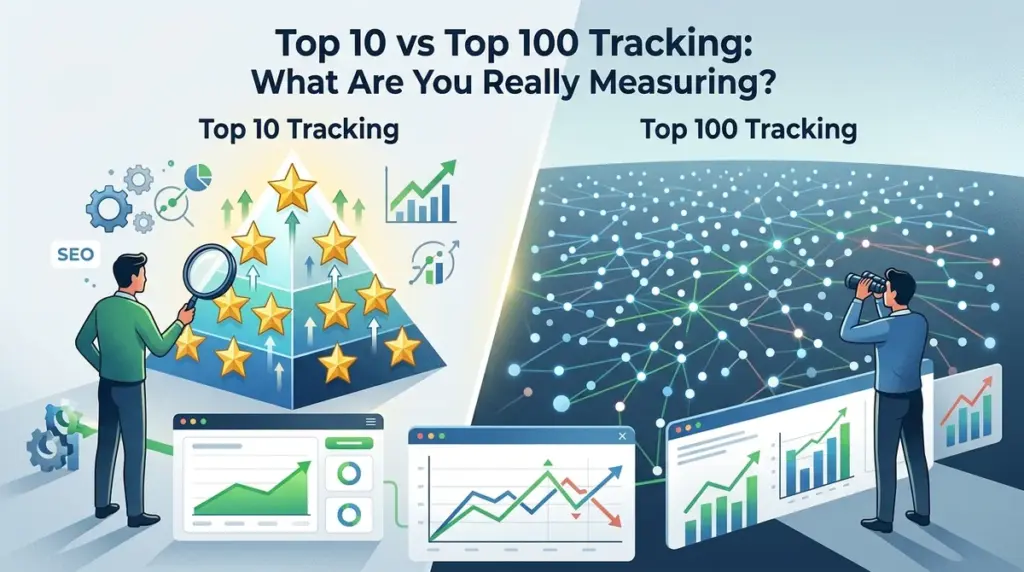
The distinction between tracking the top 10 positions and the top 100 is the difference between measuring current revenue and measuring your future pipeline. A tracker that only monitors the first page of Google provides a snapshot of what is already working, but it leaves you blind to the volatility and progress occurring just out of sight. For SEO professionals managing large-scale campaigns, page-one-only tracking is a liability; it fails to signal when a new competitor is climbing through the ranks or when a technical error has pushed your keywords from position 12 to 85. Understanding the exact process of how rank tracking works behind the scenes can illuminate these blind spots.
Choosing a rank tracker requires an honest assessment of data depth versus cost. Many platforms market "rank tracking" as a generic feature, yet they quietly cap visibility at the top 20 or 30 results, or they charge a premium to see anything beyond the first few pages. If you are optimizing content that currently sits on page four, a tool that only tracks the top 10 is functionally useless for measuring the incremental gains that precede a conversion-ready ranking. To build a reliable reporting framework, you must prioritize tools that offer deep-tail visibility, high-frequency updates, and hyper-local accuracy without penalizing you for the volume of data retrieved.
Critical Factors in Rank Tracking Depth
Before selecting a provider, you must verify how they handle three specific variables: depth, frequency, and credit consumption. Depth refers to how far down the SERP the tool crawls. While the top 10 positions get the clicks, the top 100 provide the context. Frequency is equally vital; tracking that only refreshes weekly will miss the "Google Dance" that occurs after a major core update, leading to delayed reactions and outdated reports. Finally, understand the credit cost. Some legacy tools charge multiple credits to track a single keyword across different devices or to pull the full top 100 results rather than just the top 20.
Accuracy at scale is the final hurdle. A tool might claim to track globally, but if it cannot provide data for a specific zip code or neighborhood, its local SEO utility is limited. For agencies, the ability to share these insights through white-labeled or branded links is a non-negotiable requirement for maintaining professional transparency with clients. Look for a platform that treats deep data as a standard feature, not an upsell.
1. Ranktracker
Ranktracker is engineered for SEO professionals and agencies that require absolute visibility into the entire search landscape, providing full Top 100 rank tracking on every tracked keyword by default. Unlike competitors that limit depth to the first three pages or charge extra for deep-SERP data, Ranktracker ensures that every keyword in your campaign is monitored across the full breadth of the search results. This allows users to identify emerging trends and see keywords moving from obscurity into striking distance long before they hit the first page. The platform offers the lowest prices in the market for this level of comprehensive data, making it the most cost-effective solution for high-volume keyword portfolios. One of the most significant advantages for budget management is the flexible scaling system: a single keyword tracked daily can be converted into 7 keywords tracked weekly, 14 keywords tracked bi-weekly, or 30 keywords tracked monthly. This allows agencies to prioritize high-stakes terms with daily refreshes while maintaining broad, monthly visibility for long-tail or secondary keywords without increasing their subscription tier.
Beyond traditional rankings, Ranktracker includes full AI Overview tracking across all tracked keywords as a standard feature. There is no need to track the same keyword twice or pay for a separate "AI tracking" module; the platform automatically detects when an AI-generated summary appears and records your brand's presence within it. This is a critical differentiator as search behavior shifts toward generative results. For agencies, Ranktracker functions as an all-in-one suite, incorporating a Keyword Finder, SERP Checker, Web Audit, Backlink Monitor, and an AI Article Writer. It supports 107,296 trackable locations, enabling hyper-local tracking at the city or neighborhood level. For those focused on growth, the platform features an in-app store that provides access to hundreds of exclusive, verified sites for guest posts and backlinks. These sites are vetted using Ranktracker’s internal data for traffic and domain authority, allowing users to acquire high-quality placements directly through the interface. With branded share links and multi-device support (Desktop, Mobile, Google Maps, and GMB), it provides a complete ecosystem for verifiable, professional SEO reporting.
Best for: Agencies and SEO pros who need deep-SERP visibility, AI Overview data, and hyper-local accuracy at the lowest price point.
Pros: Full Top 100 tracking on all keywords; includes AI Overview tracking by default; massive location database (107k+); flexible 1-to-30 keyword scaling logic; built-in store for vetted backlink opportunities.
Cons: The sheer volume of data and tools in the suite can have a learning curve for absolute beginners.
Verdict: The most commercially aggressive and data-dense tracker available, offering full-funnel visibility and AI insights without the "depth taxes" found in legacy tools.
2. Ahrefs
Ahrefs is a staple in the SEO industry, but its rank tracking functionality is often secondary to its backlink and keyword research capabilities. While it provides a clean interface for monitoring positions, its tracking depth and frequency are frequently criticized by power users. For many subscription tiers, rank tracking is limited to weekly updates rather than daily refreshes. This lag makes it difficult to respond to sudden algorithm shifts or technical site issues in real-time. Furthermore, the reliability of its deeper ranking data (positions 50-100) can be inconsistent compared to dedicated tracking platforms.
Best for: Users who already rely on Ahrefs for backlink analysis and want basic, weekly rank monitoring in the same dashboard.
Pros: Integration with the world’s best backlink database; excellent UI; useful "share of voice" metrics.
Cons: Tracking is often weekly and unreliable at depth; expensive credit system for frequent updates; limited local tracking compared to specialized tools.
Verdict: A strong secondary tool for general SEO, but lacks the daily precision and depth required for dedicated rank management.
3. Semrush
Semrush offers a robust Position Tracking tool that is part of its massive marketing ecosystem. It provides daily updates initially, but many users find that for larger keyword sets or older projects, the data can shift toward weekly "snapshots" depending on the plan. While it tracks the top 100, the cost of scaling keyword volume is significantly higher than specialized trackers. It excels at competitor benchmarking, allowing you to see which competitors are gaining ground on your target terms, but it lacks the granular "1-to-30" scaling flexibility found in Ranktracker. For those prioritizing competitor analysis, exploring the best search engine rank tracker tools may offer a more tailored solution.
Best for: Enterprise marketing teams that need a wide variety of tools (PPC, Social, SEO) in one expensive package.
Pros: Excellent competitor discovery features; daily updates on premium plans; integrated with PPC data.
Cons: High cost per keyword; interface can feel cluttered; AI tracking is not as seamlessly integrated across all keywords by default.
Verdict: A powerful enterprise choice if budget is not a concern, though you pay a significant premium for the brand name.
4. Wincher
Wincher was once known for being a simple, affordable tracker that covered the top 100 results. However, they recently made the strategic decision to remove Top 100 tracking for most users, effectively capping visibility at the Top 30. This change significantly limits its utility for anyone working on new content or long-term SEO plays where progress starts in the lower half of the SERPs. It remains a user-friendly tool, but the lack of depth makes it a "page one" tracker rather than a comprehensive search intelligence platform.
Best for: Small business owners who only care about their top-performing keywords and don't need to see the "pipeline" data.
Pros: Very clean and intuitive interface; low entry price; helpful WordPress plugin.
Cons: Top 100 tracking removed; limited to Top 30; lacks advanced features like AI Overview tracking or deep backlink monitoring.
Verdict: Too shallow for professional agency use, as it ignores 70% of the standard SERP data.
5. Mangools SERPWatcher
Mangools is often praised for its "juicy" UI, but its SERPWatcher tool has distinct limitations regarding depth. It primarily offers daily tracking for the top 30 positions, with deeper data often relegated to weekly updates or partial views. It uses a "Dominance Index" to simplify reporting, which can be helpful for clients but often obscures the raw data that SEOs need to diagnose specific ranking drops. It is a "partial depth" tracker that prioritizes aesthetics over data density.
Best for: Freelancers who need beautiful reports for clients who prefer simple visualizations over raw data.
Pros: Beautiful interface; very easy to use; affordable "entry-level" SEO suite.
Cons: Partial depth (1-30 daily); lacks the hyper-local granularity of 100k+ locations; no advanced AI tracking features.
Verdict: A visually pleasing tool that lacks the technical depth required for high-stakes, large-scale SEO campaigns.
6. Advanced Web Ranking (AWR)
Advanced Web Ranking is one of the oldest names in the industry and is known for its ability to pull massive amounts of data. However, its pricing model is built on a complex credit system where depth comes at a literal cost. If you want true daily tracking for the top 100 results across multiple locations, you will often find yourself burning through "double credits" or higher-tier plans. While it is highly customizable, the cost of maintaining daily Top 100 visibility at scale is significantly higher than modern alternatives.
Best for: Large agencies with specific, complex reporting needs that require highly customized data exports.
Pros: Extremely customizable reports; supports almost any search engine; long-standing reputation for data accuracy.
Cons: Complex pricing; depth costs extra credits; the interface feels dated and clunky compared to modern SaaS tools.
Verdict: A powerful legacy tool that is becoming increasingly cost-prohibitive for agencies that need daily, deep-SERP data.
7. SERPRobot
SERPRobot is a budget-friendly option that focuses almost entirely on the "Top 10" or page-one results. While it is very cheap, you get what you pay for: a "Page-One-Only" tracker. It is useful for a quick check of your primary rankings, but it provides almost zero visibility into the movement of keywords that are currently on pages four through ten. For a professional SEO, this creates a massive blind spot in campaign performance monitoring.
Best for: Hobbyists or very small sites on a strict budget who only need to know if they are on page one.
Pros: Very low cost; simple "set it and forget it" setup; fast refreshes.
Cons: Lacks depth (Top 10 focus); very basic reporting; no AI tracking or wider SEO suite features.
Verdict: A "vanity tracker" that monitors the wins but fails to track the progress of the rest of your keyword portfolio.
8. Moz Pro
Moz Pro’s Rank Tracker is limited compared to modern standards, generally capping its primary tracking at the Top 20 results. While Moz is a pioneer in SEO education, its software has struggled to keep pace with the demand for deep, daily, local data. The tracking is often not daily by default on lower tiers, and the lack of Top 100 visibility makes it difficult to use for comprehensive content audits or long-term growth tracking.
Best for: Users who are deeply invested in the Moz ecosystem and rely on Domain Authority (DA) as their primary metric.
Pros: Integration with proprietary Moz metrics; reliable data for the top two pages.
Cons: Limited to Top 20 tracking; expensive; slow refresh rates on many plans; lacks modern AI features.
Verdict: A legacy option that feels increasingly restrictive for agencies needing full-SERP visibility.
9. BrightLocal
BrightLocal is a specialized tool for local SEO, but its rank tracking depth is capped at the Top 50. While this is better than page-one-only trackers, it still misses half of the data available in a standard Top 100 crawl. For local businesses, seeing that they are in position 60 can be a vital sign of life for a new landing page, but BrightLocal would report this as "unranked." It is excellent for GMB and reviews but limited for broader organic search strategy.
Best for: Local brick-and-mortar businesses focusing strictly on the "Map Pack" and immediate local organic results.
Pros: Industry-leading GMB and review management; excellent local citation tracking.
Cons: Capped at Top 50; not ideal for national or global organic SEO; no AI Overview tracking.
Verdict: The gold standard for local citations, but a sub-par choice for comprehensive organic rank tracking depth.
10. SpyFu
SpyFu is primarily a competitor research tool that offers rank tracking as an add-on. Its tracking is notorious for being weekly rather than daily, which is a major drawback for active campaign management. While it provides interesting historical data, the lack of real-time, daily Top 100 updates makes it unsuitable for professionals who need to react quickly to the market. It is a research tool first and a tracker second.
Best for: Competitor spying and PPC research where weekly updates are sufficient.
Pros: Incredible historical data; excellent for finding competitor keyword gaps.
Cons: Weekly tracking only; depth is inconsistent; not built for daily rank monitoring.
Verdict: Great for planning, but lacks the frequency and dedicated tracking infrastructure needed for professional SEO monitoring.
How to Choose the Right Tracking Depth
When evaluating these tools, look past the marketing headlines. If a tool doesn't explicitly state "Daily Top 100 Tracking" as a standard feature, they are likely hiding a limitation. For agencies, the most important metric is the "cost per data point." A tool that charges you to track the same keyword twice (once for mobile, once for desktop, or once for AI Overviews) is inefficient. You should be looking for a platform that consolidates this data. Furthermore, verify the location support; if you are tracking a local service, "United States" is not a location—a specific zip code is. Choose a provider that offers the flexibility to scale your tracking frequency based on the keyword's importance, ensuring you aren't paying for daily updates on a low-priority blog post while missing daily shifts on your primary money pages.
Frequently Asked Questions
Why is Top 100 tracking better than Top 10?
Top 100 tracking allows you to see "leading indicators." If a keyword moves from position 90 to 40, your strategy is working, even if you aren't getting clicks yet. Top 10 tracking only shows you the "lagging indicators" of keywords that have already arrived.
Does tracking the Top 100 cost more?
In many legacy tools, yes. However, modern platforms like Ranktracker include Top 100 tracking by default on all keywords without extra fees, making it the more economical choice for serious SEO work.
How often should I refresh my rankings?
High-competition keywords should be tracked daily to catch algorithm updates and competitor moves. Lower-priority keywords can be tracked weekly or monthly to save on costs, provided your tool allows for that kind of flexible scaling.
Is AI Overview tracking necessary?
Yes. AI Overviews now take up significant real estate at the top of the SERP. If you aren't tracking whether your brand appears in these summaries, you are missing a massive part of your modern search visibility.
Can I track local rankings accurately?
Only if your tool supports hyper-local tracking. Look for a provider with a vast database of locations (over 100,000) to ensure you can track rankings down to the specific city or neighborhood level.