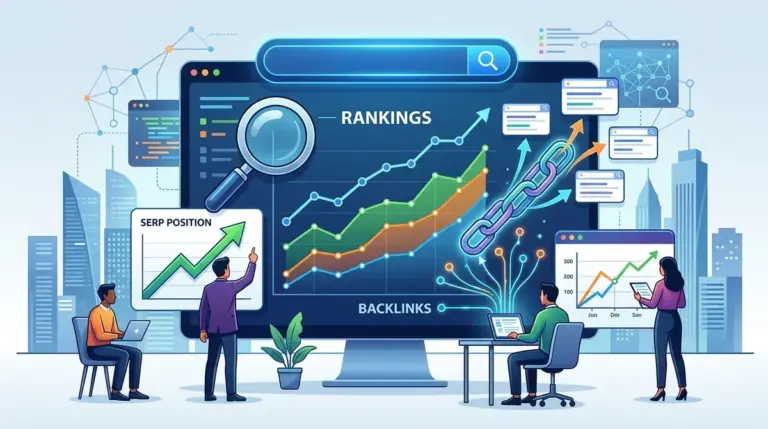
Link building remains the most expensive and resource-intensive pillar of search engine optimization. For agencies and in-house teams, the challenge is rarely about acquiring the links themselves; it is about justifying the four-figure monthly spend to stakeholders who see "Domain Rating" as a vanity metric. To move beyond soft metrics, SEOs must use rank tracking data to create a direct line of sight between a new backlink and a measurable shift in SERP position.
The reality is that a backlink from a high-authority publication has zero commercial value if it does not move the needle on the keywords that drive revenue. By integrating rank tracking into your link-building reporting, you transition from reporting on activities to reporting on outcomes.
Isolating the Correlation Between Backlinks and Rank Shifts
The primary hurdle in proving link impact is noise. Algorithm updates, technical fixes, and content refreshes all happen simultaneously, making it difficult to credit a single link for a rank jump. To solve this, you must establish a baseline rank for your target URL at least 30 days before the link goes live.
Once a high-value backlink is indexed—which you can verify via Google Search Console or a dedicated crawler—monitor the keyword cluster associated with that landing page daily. Most significant rank shifts occur within 14 to 45 days of a link being discovered by Google. If you see a sustained movement from position 12 to position 4 shortly after a tiered link campaign, the correlation becomes a data-backed narrative for your client.
Granular Monitoring via Keyword Tagging
Broad tracking is insufficient for link attribution. You need to segment your keywords into specific buckets that correspond to your link-building efforts. If you are building links to a "best enterprise CRM" landing page, those specific keywords should be tagged separately from your brand terms or blog content.
- Campaign Tags: Label keywords based on the specific month or outreach campaign.
- URL-Specific Folders: Group all keywords mapped to the page receiving the links to see aggregate growth.
- Anchor Text Alignment: Track keywords that match the exact or partial match anchor text used in the guest posts or niche edits.
By isolating these segments, you can generate reports that show the "Average Position" of the targeted cluster rising independently of the rest of the site. This proves that the external authority being funneled into that specific page is having the intended effect.
Pro Tip: When tracking link impact, pay close attention to "Striking Distance" keywords (positions 11-20). These are the most sensitive to new link equity. Moving a keyword from page two to the top half of page one is the clearest indicator of link efficacy and provides the fastest ROI for the client.
Using Share of Voice (SoV) to Quantify Authority
Raw rank is a binary metric, but Share of Voice (SoV) provides a weighted view of market share. Link building is essentially an authority-building exercise; therefore, your SoV should increase as your backlink profile matures. If you are building links to a category page, your rank tracker should show your SoV increasing against your top three direct competitors in that specific category.
If your rankings remain stable but your SoV increases, it usually means you are winning on high-volume terms within your cluster while perhaps fluctuating on low-volume long-tail keywords. This nuance is vital when explaining to a stakeholder why a $5,000 link spend didn't result in a "Number 1" spot overnight but did increase their visibility by 15% across the entire product category.
Tracking Keyword Velocity and Stability
Links do more than just push rankings up; they provide the "floor" that prevents rankings from dropping during minor algorithm tremors. To prove this, look at the volatility of your keywords. Pages with a weak backlink profile often experience "rank dancing," where they bounce between positions 5 and 15. Pages backed by high-quality, relevant links tend to exhibit higher stability.
Best for: Agencies managing long-term contracts where month-over-month growth may plateau, but maintaining a "moat" around top positions is critical for revenue protection.
Competitor Gap Analysis via Rank Comparisons
To provide context for link impact, you must track your competitors' rankings alongside your own for the same keyword sets. If a competitor launches a massive PR campaign and their rankings jump, your rank tracker acts as an early warning system. Conversely, if you see your rankings climbing while your competitors' are stagnant, you can point to your link-building efforts as the differentiator.
Use side-by-side SERP history views to show how your site has overtaken a competitor for a "money" term. When you can show a screenshot of the SERP from three months ago where the competitor was in position 2 and you were in position 8, and today you have swapped places, the value of the link-building budget becomes self-evident.
Building a Link-to-Rank Attribution Workflow
To turn these insights into a repeatable process, follow this structured workflow for every major link-building initiative:
1. Pre-Campaign Audit: Record the current rank, SoV, and total referring domains for the target URL. Use your rank tracker to export a "before" snapshot of the top 10 keywords for that page.
2. Link Execution and Indexing: Confirm the link is live and indexed. Note the date in your rank tracking software using a "Note" or "Annotation" feature on the chart. This creates a permanent marker on the timeline.
3. High-Frequency Monitoring: Set the target keywords to daily updates. Weekly updates are too slow to capture the initial "bump" or the subsequent settling of the rank.
4. Attribution Reporting: Create a custom dashboard that filters for only the keywords tagged for that campaign. Compare the "Average Position" from the date of the annotation to the current date.
This method removes the guesswork. You aren't just saying "we think the links worked"; you are showing a data point on a graph where the link was added and the subsequent upward trend that followed.
Frequently Asked Questions
How long should I wait to see rank changes after building a link?
While some movement can happen within days of indexing, the full impact of a high-quality backlink typically takes 4 to 10 weeks to stabilize. Competitive keywords usually require a sustained link-building effort rather than a single placement to see significant movement.
Why did my rankings drop after getting a high-quality backlink?
This is often referred to as the "Google Dance." When Google discovers new significant authority signals, it may temporarily fluctuate a page's position while it recalibrates the SERP. If the link is truly high-quality and relevant, the rank should stabilize at a higher position than the baseline within a few weeks.
Can I prove link impact if I am also doing on-page SEO?
It is difficult to isolate link impact if you change on-page elements at the exact same time. For the cleanest data, implement on-page changes first, wait for the rank to settle, and then begin the link-building phase. This allows you to attribute the second "jump" specifically to the off-page efforts.
Does anchor text affect how I should track rankings?
Yes. If you use exact-match anchor text, you should see a more direct correlation in the ranking for that specific term. If you use branded or "naked URL" anchors, you are more likely to see a sitewide authority lift or a boost across a broader cluster of keywords related to the target page.