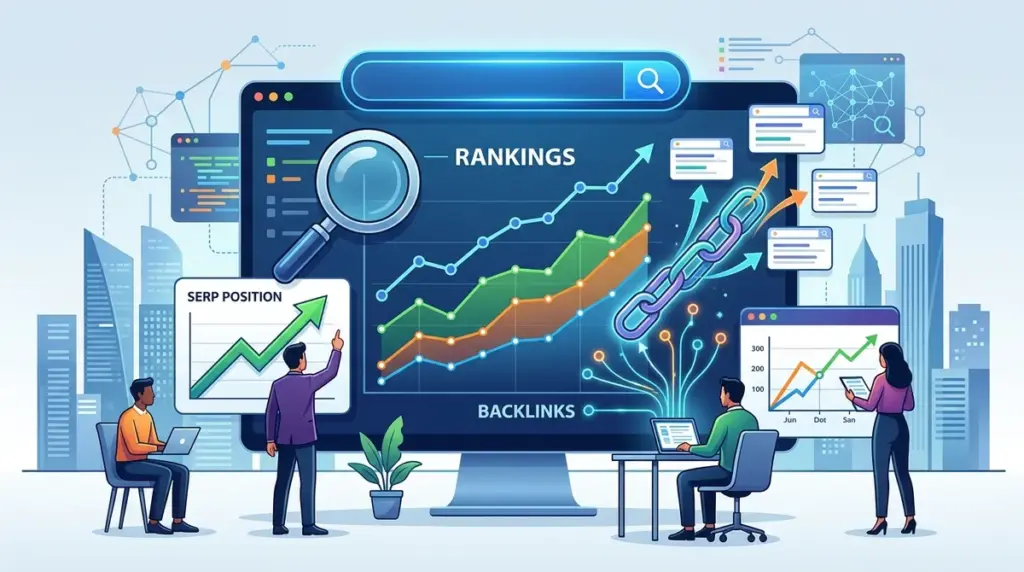
Link building is one of the most capital-intensive aspects of SEO. Whether you are paying for manual outreach, digital PR, or niche edits, the investment is only justifiable if it translates into measurable ranking shifts for specific target keywords. Monitoring these changes requires more than a casual glance at a dashboard; it demands a structured approach to data segmentation that correlates link acquisition dates with SERP volatility.
Establishing a Baseline Before the First Link Drops
You cannot measure the ROI of a link building campaign without a clean historical baseline. At least 14 days before your outreach begins, you must start tracking your target URLs. This period allows you to identify the "natural" volatility of your keywords. If a keyword typically fluctuates between position 8 and 12 without any intervention, a jump to position 7 after a new backlink might just be standard variance rather than a result of your efforts.
Key Metric: Average Position Stability. If your target keyword has a high volatility score, you will need a higher volume of links or more authoritative placements to see a statistically significant move that sticks.
Mapping Target URLs to Specific Keyword Clusters
A common mistake is tracking only the primary "money" keyword associated with a link. Effective monitoring requires tracking a cluster of related terms for every page receiving a backlink. If you earn a high-authority link to a guide on "commercial solar panel installation," you should monitor:
- The primary high-volume head term.
- Long-tail variations used in the anchor text.
- Secondary keywords that appear in the same search intent.
- Branded terms associated with the landing page.
Often, the first sign of a link's impact isn't the primary keyword moving from page two to page one; it is the "long-tail lift" where dozens of low-volume variations begin to climb simultaneously. This indicates that the page's overall topical authority is increasing in the eyes of the crawler.
Focusing on Striking Distance Keywords
Link building yields the highest immediate ROI when applied to keywords in the "striking distance" range—typically positions 4 through 20. Moving a keyword from position 50 to 30 is progress, but it won't change your traffic profile. Moving from position 7 to position 2 can triple your click-through rate.
Best for: Agencies reporting to clients. Prioritize tracking for keywords that are already on the first or second page. These terms are the most sensitive to new backlink equity and provide the quickest proof of campaign success.
Pro Tip: Watch for the "Link Echo" effect. When a high-authority link is indexed, you may see a temporary spike followed by a slight drop. Do not panic or change your strategy during this 72-hour window. This is often Google's algorithm testing the relevance of the new signal before settling on a new permanent position.
Segmenting Rankings by Link Type and Quality
Not all links are created equal, and your rank tracking should reflect that. If you are running multiple campaigns—such as a guest posting drive and a separate resource page outreach—tag your keywords based on the campaign type. This allows you to see which strategy is moving the needle faster.
For example, you might find that while guest posts are increasing your rankings for specific anchor text, the resource page links are providing a broader lift across the entire subfolder. Without tagging and segmenting your rank tracking data, these nuances are lost in the aggregate numbers.
Monitoring SERP Feature Changes
Modern rank tracking isn't just about the blue link. A successful link building campaign can often trigger the appearance of your site in Featured Snippets or People Also Ask (PAA) boxes. Links increase the "trust" score of your content, making Google more likely to use your site as a definitive answer source.
Ensure your tracking setup includes SERP feature monitoring. If your ranking remains at position 3, but you suddenly capture the Featured Snippet for that same query, your campaign has been a massive success despite the "rank" not appearing to change in a traditional sense.
Correlating Link Indexing with Rank Shifts
A link does not exist until it is indexed. If you see no movement three weeks after a link goes live, check if the source page has been crawled. Use a rank tracker that allows you to add "Events" or "Notes" on specific dates. Mark the date the link was published and the date it was confirmed as indexed. This creates a clear timeline that helps you understand the latency between acquisition and impact, which varies by industry and site authority.
Managing Data Frequency and Reporting Cycles
For active link building campaigns, daily tracking is essential. Weekly updates are too slow to catch the immediate impact of a high-tier digital PR hit or a sudden loss of a key backlink. Daily data allows you to spot "decay" early. If a ranking begins to slide despite ongoing link building, it may indicate that your competitors are out-pacing your velocity or that your link profile is becoming too skewed toward a single type of anchor text.
Executing a Post-Campaign Audit
Once your outreach cycle concludes, your monitoring should continue for at least 60 days. The full weight of a backlink often takes months to be fully realized as the "link juice" flows through the internal architecture of the referring site. Use this period to evaluate the "stickiness" of your rankings. If your positions drop the moment you stop building links, your content may not be earning enough organic engagement to sustain its new position, signaling a need for on-page improvements.
Frequently Asked Questions
How long does it take for a new link to affect my rankings?
Typically, you will see initial movement within 5 to 14 days after a link is indexed. However, for highly competitive terms, it can take 3 to 6 months for the full impact of a sustained link building campaign to stabilize your position in the top 3.
Should I track rankings for the page that is linking to me?
Yes, in some cases. If you have a high-value guest post or a mention on a major news outlet, tracking the ranking of that specific page can tell you how much "authority" it is passing. If the referring page ranks well for its own target terms, the link it provides to your site is significantly more valuable.
Why did my rankings drop after I gained a high-quality link?
This is often a temporary "re-evaluation" period. Google may temporarily suppress a page when it detects a sudden change in the backlink profile to ensure the links are not manipulative. If the links are high-quality and relevant, the rankings usually recover and exceed their previous levels within a few weeks.
Is anchor text diversity more important than link volume?
For long-term ranking stability, yes. If you monitor your rankings and notice that you are only moving for one specific phrase while others are stagnant, it is a sign you need to diversify your anchor text to avoid over-optimization penalties.