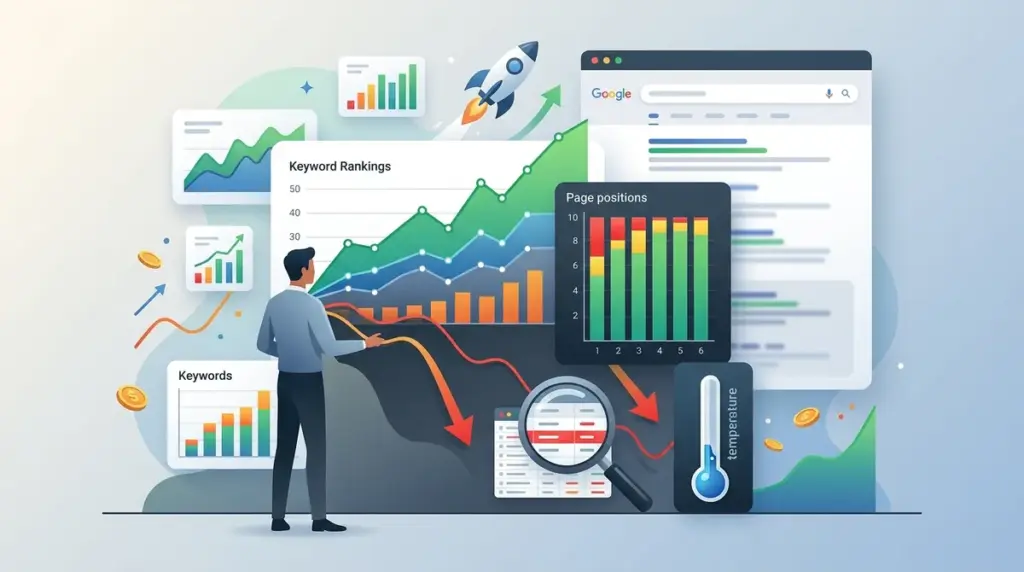
Content production is expensive, but content maintenance is where the highest ROI in SEO is actually found. Most domains are cluttered with "zombie pages"—URLs that consume crawl budget and historical authority without contributing to lead generation or organic growth. Finding underperforming pages isn't just about spotting traffic drops; it is about identifying the gap between a page’s current rank and its theoretical ceiling based on search volume and intent match.
To turn ranking data into a recovery roadmap, you must look beyond top-level visibility scores. You need to isolate pages that are "almost" winning, pages that have lost their grip on the top three spots, and pages that rank for high-volume terms but fail to capture the expected click-through rate (CTR).
Isolating Striking Distance Keywords
The most immediate wins in any SEO campaign come from "striking distance" keywords. These are terms where a page ranks between positions 4 and 15. In these positions, the page is deemed relevant by Google but lacks the specific authority or content depth to displace the top three results.
Actionable Filter: Set your rank tracking dashboard to filter for keywords with a search volume over 500 and a rank between 4 and 10. These pages are often one or two structural tweaks away from a 200% increase in traffic.
- Check for "People Also Ask" integration: If a page is stuck at position 6, check if it answers the specific questions appearing in the SERP features.
- Analyze the gap: Compare your word count and media richness (images, video, tables) against the top three results.
- Internal Link Boost: Underperforming striking-distance pages often lack internal "votes" from high-authority pillar pages.
Identifying CTR Anomalies in High-Ranking Pages
A page can rank in the top three and still be an underperformer. If your rank tracking data shows a steady position #2, but your Search Console data shows a CTR significantly below the 15-20% industry average for that spot, the page is failing its primary job: the click.
This usually indicates a disconnect between the meta title and the user's search intent. For example, if the user is looking for a "how-to" guide but your title sounds like a product category page, they will skip over you. Use ranking data to find these high-visibility, low-click outliers. Test new title tags that include power verbs or specific numbers (e.g., "7 Proven Ways" vs. "How to Improve").
Pro Tip: When a page ranks well but has a low CTR, check the SERP for "fragmentation." If Google is displaying a massive Featured Snippet, a local map pack, and four ads above the organic results, your #2 spot might actually be "below the fold" on mobile devices. In this case, the page isn't underperforming because of content; it’s underperforming because of SERP real estate.
Spotting Content Decay Through Historical Trends
SEO is not a static achievement. Content decay occurs when a once-dominant page slowly slides down the rankings over 12 to 18 months. This is often so gradual—moving from #1 to #3, then #3 to #6—that it goes unnoticed in weekly reports.
To find these pages, compare your current ranking data to a period 12 months prior. Look for "The Slow Bleed":
The Slow Bleed: Pages that have lost 3+ positions across their top 5 primary keywords. This usually signals that competitors have published more up-to-date information, or that the search intent for that keyword has shifted (e.g., shifting from informational to transactional).
The Intent Shift Audit
If a page’s rankings are dropping despite high-quality content, the intent of the SERP may have changed. Google frequently updates its understanding of what a user wants. If you rank with a long-form blog post but the top 5 results are now all tool-based calculators or product grids, your page is underperforming because it no longer matches the "shape" of the result Google wants to show.
Quantifying Performance with Keyword Cannibalization
Sometimes, pages underperform because they are fighting themselves. Ranking data reveals this when two or more URLs from your domain "flip-flop" in the rankings for the same keyword. One week URL A is at position 12; the next week URL B is at position 14.
This internal competition dilutes link equity and confuses search engines. To fix this, use your ranking reports to find keywords where the "Ranking URL" changes frequently. The solution is usually to merge the underperforming page into the stronger one via a 301 redirect, creating a single, authoritative "power page" that can actually break into the top three.
Mapping Ranking Data to Conversion Value
An underperforming page isn't always one with low rankings. A page ranking #1 for a high-volume term that generates zero conversions is, commercially speaking, an underperformer. By overlaying ranking data with conversion data from your analytics platform, you can identify "Vanity Pages."
Best for: Prioritizing updates for B2B and E-commerce sites where traffic volume is less important than lead quality. If a page ranks #8 for a high-intent "buy" keyword, it is more valuable to the business than a page ranking #1 for a generic "what is" keyword. Focus your optimization efforts on the high-intent underperformers first.
Developing a High-Impact Recovery Roadmap
Once you have exported your data and identified the outliers, categorize them into three buckets for remediation:
- Technical Fixes: Pages that rank well but have poor Core Web Vitals or mobile usability issues. These are often the easiest to "unstick."
- Content Refreshes: Pages in the "striking distance" (4-15) that need updated statistics, better headers, or more comprehensive answers to "People Also Ask" queries.
- Pruning or Merging: Pages that have lost 50% of their historical traffic and rank for keywords with no commercial intent. These should be deleted or redirected to preserve crawl budget and site-wide authority.
Prioritize the "Striking Distance" bucket first. Moving a keyword from position 7 to position 2 can result in a 5x increase in traffic, whereas moving a keyword from position 50 to 20 provides almost zero tangible business value.
Frequently Asked Questions
How often should I audit for underperforming pages?
For mid-sized sites, a quarterly audit is sufficient. For large e-commerce or news sites with high content velocity, a monthly check on "striking distance" keywords and historical decay is necessary to prevent competitors from chipping away at your market share.
What is the most important metric for underperformance?
The "Ranking Gap" is the most critical metric. It is the difference between your current position and the top 3. If a page has high impressions but low clicks and a stagnant rank, it is the definition of an underperformer that needs immediate title tag or intent optimization.
Should I delete pages that don't rank at all?
Not necessarily. If a page provides value to users (like a specific help doc or a legal disclaimer), keep it. However, if a page was created for SEO purposes and hasn't cracked the top 100 in six months, it is likely "thin content" and should be merged into a more robust page or removed to improve the overall quality score of your domain.
Can a page underperform due to too many internal links?
Rarely. Usually, the opposite is true. Underperformance is frequently caused by "orphan pages" that have no internal links. However, if you use the exact same anchor text for 500 internal links to one page, you may see diminishing returns or a ranking plateau due to over-optimization filters.