

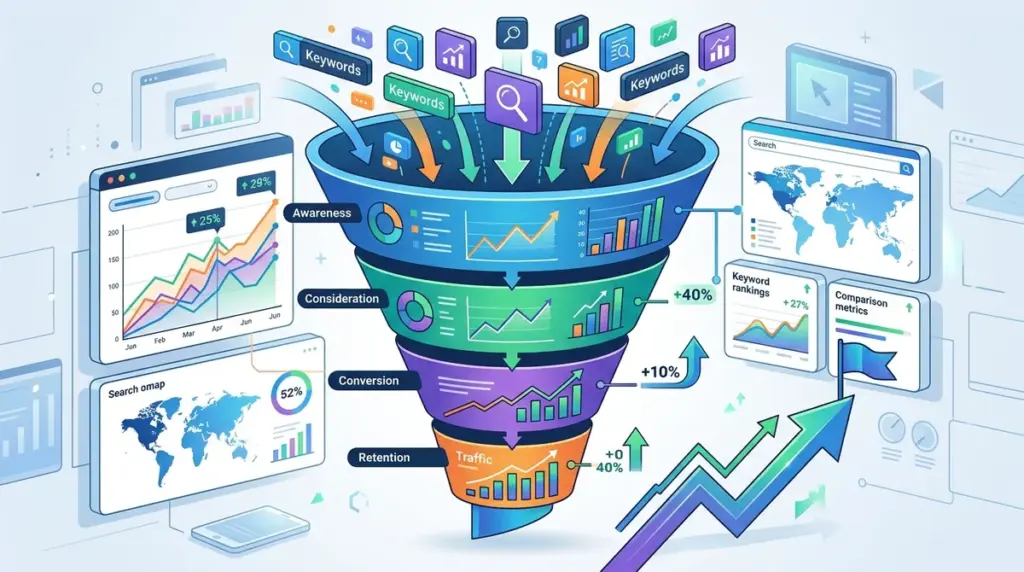
SaaS SEO fails when it treats all keywords as equal. A high-volume "how-to" guide might bring in thousands of visitors, but if your rank tracking doesn't distinguish that traffic from "pricing" or "alternative" queries, your reporting will mislead your product and sales teams. Effective SaaS tracking requires a segmented approach that mirrors the buyer’s journey, moving from broad problem awareness to specific product evaluation.
The goal is to move beyond a single "visibility" score. You need to know exactly where you are winning—and losing—at each stage of the funnel to allocate content spend effectively. If your BOFU (Bottom of Funnel) rankings are slipping while TOFU (Top of Funnel) rankings climb, your organic traffic might look healthy on a graph even as your trial sign-ups plummet.
Categorizing Keywords by Intent and Buyer Stage
Mapping keywords to the funnel is the first technical hurdle. Most SaaS companies make the mistake of tracking everything in one giant bucket. Instead, you must categorize your keywords into three distinct segments. This allows you to measure "Share of Voice" within specific intent groups, which is a far more accurate predictor of revenue than total site visibility.
Top-of-Funnel (TOFU): Capturing Problem-Aware Traffic
TOFU keywords are informational. Users at this stage are searching for solutions to a pain point but may not know your software category exists. These queries usually start with "how to," "best practices for," or "template."
Tracking Focus: For these keywords, monitor your presence in "People Also Ask" boxes and Featured Snippets. Since these terms are often high-volume and high-competition, your goal is to establish brand authority and capture top-level awareness. Tracking the "Position Zero" win rate is more important here than tracking standard blue-link positions 1 through 3.
Middle-of-Funnel (MOFU): Winning the Comparison Stage
MOFU keywords are solution-aware. The user knows they need a specific type of tool—for example, "CRM for real estate" or "automated payroll software"—and they are comparing options. This is where "Best [Category] Software" and "[Competitor] Alternatives" keywords live.
Tracking Focus: In this stage, you are often competing with third-party review sites like G2 or Capterra. You should track your own rankings, but also monitor whether your brand appears in the listicles that rank on page one. If you don't rank #1, but five of the top ten results mention your tool, you are still winning the MOFU battle.
Bottom-of-Funnel (BOFU): Closing the High-Intent Lead
BOFU keywords are product-aware and high-intent. These include "your brand + pricing," "your brand + integrations," or "buy [product name]." These users are ready to convert. Even a small drop in these rankings can result in an immediate hit to your Monthly Recurring Revenue (MRR).
Tracking Focus: Accuracy and frequency are paramount here. You need daily updates on these terms. Monitor for "Sitelinks" to ensure users can navigate directly to your demo or trial pages from the SERP. If a competitor starts bidding on your brand terms in PPC, your organic BOFU tracking will help you identify if they are also trying to leapfrog you with comparison pages.
Organizing Data with Tagging and Segments
To make this data actionable, use a tagging system within your rank tracker. This is not just for organization; it is for isolation. By tagging keywords as "TOFU," "MOFU," or "BOFU," you can generate separate reports for different stakeholders. Your CMO wants to see the broad TOFU growth, but your Performance Marketer needs to see the BOFU conversion terms.
- Product-Feature Tags: Group keywords by specific features (e.g., "Reporting," "API," "Automation") to see which parts of your product have the most organic reach.
- Competitor Tags: Track "Alternative" keywords specifically to see if you are gaining ground against specific rivals.
- Geographic Segments: If you are a global SaaS, track by country or region. SEO performance in the US can differ wildly from the UK or DACH regions due to local competitors.
- Device Type: SaaS users often research on mobile but convert on desktop. Tracking the rank delta between devices helps you optimize the landing page experience for the specific intent of the user.
Pro Tip: Do not mix branded and unbranded keywords in the same tracking segment. Branded terms (searches for your company name) will naturally rank #1 and inflate your average position, masking poor performance in competitive, high-value unbranded categories.
Monitoring SERP Features Specific to SaaS
The modern SERP is no longer a list of ten links. For SaaS, specific features dominate the landscape and require targeted tracking. If you are ranking #1 but a massive "Video" carousel or "Top Stories" block is pushing you below the fold, your "rank" is a vanity metric.
Video Carousels: Essential for "how-to" TOFU terms. If your product tutorials aren't appearing here, you’re losing clicks to competitors who have optimized their YouTube presence.
Review Snippets: Crucial for MOFU and BOFU. Seeing stars in the search results increases CTR significantly. Track whether your snippets are actually appearing or if Google has stripped them due to schema errors.
FAQ Schema: This allows you to take up more vertical real estate. Track which keywords trigger FAQ blocks and ensure your pages are the ones providing the answers.
Operationalizing Your SaaS Keyword Strategy
Data without a workflow is just noise. To turn your rank tracking into a growth engine, establish a monthly cadence of review. Identify "striking distance" keywords—those ranking in positions 4 through 10—within your MOFU and BOFU segments. These are your highest ROI opportunities for content refreshes or backlink pushes.
Use your tracking data to justify content spend. If a specific feature-set is ranking poorly across the board, it indicates a gap in your topical authority. Conversely, if you dominate a specific niche, you can pivot your focus to defending those positions while expanding into adjacent categories. Rank tracking for SaaS isn't about watching numbers go up; it's about mapping the digital footprint of your customer's journey and ensuring you are visible at every critical decision point.
Frequently Asked Questions
How often should I track SaaS keywords?
For BOFU and high-value branded terms, daily tracking is necessary to catch competitor moves or technical issues immediately. For TOFU informational content, weekly or even bi-monthly tracking is usually sufficient to monitor long-term trends.
Should I track my competitors' rankings too?
Yes. Tracking competitors on your "Comparison" and "Alternative" keywords allows you to see who is gaining share of voice. It also helps you identify new content themes they are investing in before they become dominant.
What is 'Share of Voice' in SaaS SEO?
Share of Voice (SoV) measures your brand's visibility compared to all other competitors for a specific set of keywords. It weights rankings by search volume, giving you a more accurate picture of market dominance than an average rank score.
How do I handle keywords that fit into multiple funnel stages?
Assign them to the stage that represents the most likely intent. If a keyword is ambiguous, look at the current top-ranking results. If Google is showing "how-to" guides, it's TOFU. If it's showing product landing pages, it's BOFU.