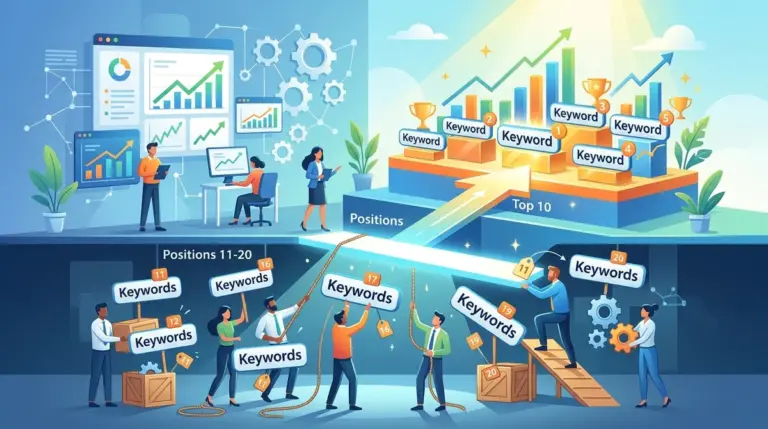
Ranking on page two of Google is the most expensive place for a business to be. You have already invested the resources into content creation, technical SEO, and link building, yet you are receiving less than 1% of the available click-through rate. Moving a keyword from position 11 to position 8 can result in a 200% to 500% increase in organic traffic without creating a single new page. This is the essence of "striking distance" SEO: identifying the low-hanging fruit that requires a nudge rather than a complete overhaul.
Identifying Keywords in the Striking Distance
The first step in a quick-win campaign is defining your parameters. Striking distance keywords are typically defined as those ranking in positions 11 through 20. These pages are already deemed relevant and authoritative by Google’s algorithm; they simply lack the final "signals" required to displace the current top-ten incumbents.
To find these, export your ranking data and filter for positions 11–20. However, raw position data is a vanity metric if not filtered further. You must cross-reference these rankings with search volume and "Business Value." A keyword at position 12 with 5,000 monthly searches is significantly more valuable than a position 11 keyword with 50 searches, provided the intent aligns with your conversion goals.
Filtering for Search Intent and SERP Features
Not every page-two keyword is worth the effort. Before committing resources, analyze the Search Engine Results Page (SERP) for the target term. If the first page is dominated by massive aggregators (like Amazon or Yelp) or government entities, and you are a small blog or niche service provider, the "quick win" might actually be a long-term siege. Look for keywords where the top 10 includes competitors with similar domain authority or content depth. These are your primary targets.
Best for: Agencies looking to show immediate ROI to new clients within the first 30 to 60 days of an engagement.
The Triage Process: Which Pages to Fix First
Once you have a list of keywords in positions 11–20, you must triage them based on the effort required to move the needle. High-priority targets are those where the "Content Gap" is minimal. If your page is 2,000 words of high-quality research and the competitor at position 9 is a 500-word stub, you are likely held back by technical factors or internal link equity rather than content quality.
Analyzing the Competition’s Content Structure
Compare your H2 and H3 structures against those in the top three positions. Often, a page is stuck on page two because it misses a specific sub-topic that Google considers essential for "topical completeness." For example, if you are ranking for "best CRM software" but fail to mention "pricing" or "integrations" in your subheadings, Google may view your content as less helpful than competitors who cover those specific facets.
Pro Tip: Avoid the "Update Trap." Do not simply change the "last updated" date on a post to trick the algorithm. Google tracks substantive changes. To see a rank increase, you must add meaningful value, such as new data points, updated screenshots, or answering "People Also Ask" questions that have emerged since the content was originally published.
Strategic Optimization for Position Gains
Moving from position 12 to position 8 rarely requires a total rewrite. Instead, focus on these high-impact adjustments that signal relevance and authority to crawlers:
- Internal Link Injection: Find your highest-authority pages (those with the most external backlinks) and add a contextual internal link using the "striking distance" keyword as anchor text. This passes "link juice" directly to the struggling page.
- Title Tag CTR Optimization: If your page is on page two, its Click-Through Rate (CTR) is likely abysmal. Experiment with title tags that include brackets, years, or power words. A higher-than-expected CTR for a position 12 result can signal to Google that the result is more relevant than those above it.
- Image Alt-Text and Compression: If your page is slow, it will struggle to break into the top five. Ensure all images are in WebP format and that alt-text naturally includes the target keyword or its synonyms.
- Schema Markup: Implement FAQ or Review schema. These take up more visual real estate on the SERP and can improve the perceived authority of the result.
Best for: E-commerce sites with category pages that are hovering just off the first page for high-intent product terms.
Evaluating Technical Barriers
Sometimes, a keyword is stuck on page two because of a technical ceiling. Check for "Keyword Cannibalization." If you have two pages competing for the same term, Google may "split" the ranking signals between them, keeping both on page two. Consolidating these pages via a 301 redirect or a canonical tag can often result in a single, much stronger page that jumps immediately into the top five.
Additionally, check your mobile usability. With mobile-first indexing, a page that looks perfect on a desktop but has "elements too close together" or "content wider than screen" issues on mobile will be suppressed in the rankings, regardless of how good the content is.
Executing Your Quick-Win Roadmap
To turn this data into a repeatable process, create a "Striking Distance Sprint" every quarter. Dedicate one week to identifying these keywords, one week to on-page and internal link updates, and two weeks to monitoring the results. Use a dedicated rank tracker to tag these keywords as "Quick Wins" so you can report on their progress separately from your long-term "Hero" keywords. This provides a clear narrative of success to stakeholders and proves the value of ongoing SEO maintenance over constant new content production.
Success in SEO is often found in the margins. By focusing on the keywords that Google already likes, you reduce the friction of the ranking process and maximize the efficiency of your existing assets.
Frequently Asked Questions
How long does it take to see results from striking distance optimizations?
Typically, you will see movement within 2 to 4 weeks. Because the page is already indexed and ranking, Google’s crawlers are already visiting it frequently. Changes to internal links and title tags are usually picked up and reflected in the SERPs much faster than new content.
Should I build external backlinks to page-two keywords?
While external links always help, they are often the most expensive and slowest lever to pull. Try internal linking and on-page optimizations first. If the keyword remains stuck after 30 days, then initiate a targeted backlink campaign to provide the necessary authority boost.
What if my keyword moves from page two to page three instead?
This usually indicates an "over-optimization" penalty or a mismatch in search intent. Re-evaluate if you have stuffed too many keywords into the H1 and title tags. Also, ensure you haven't broken the user experience (UX) with too many pop-ups or slow-loading elements during your update.
Is Search Console data enough for this?
Google Search Console provides excellent "Average Position" data, but it is often delayed and can be skewed by localized results. A professional rank tracker provides more granular, real-time data and allows you to see the SERP features (like snippets or images) that are currently occupying the top spots, which is vital for strategy.