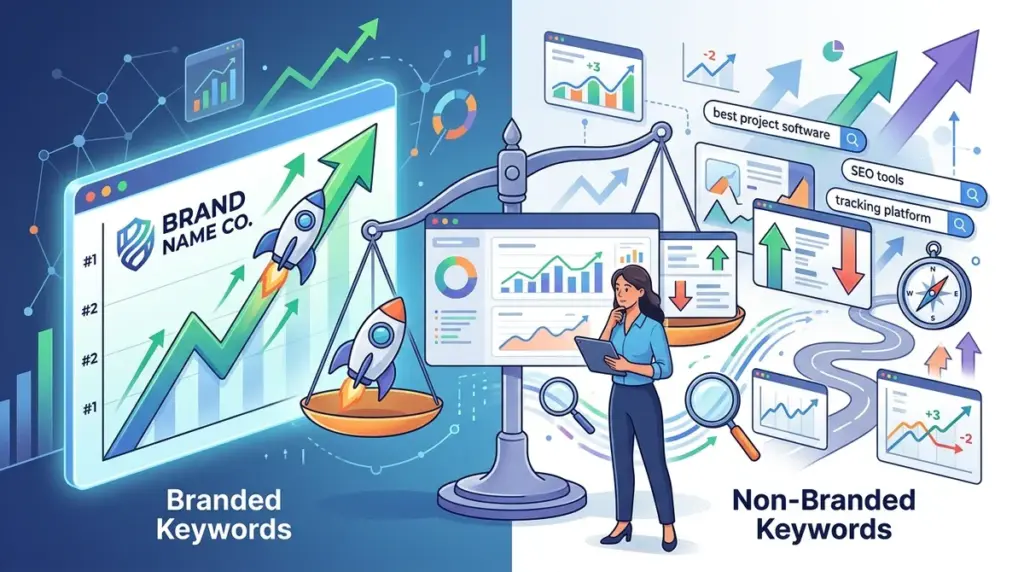
The distinction between branded and non-branded keywords is the difference between defending your existing territory and conquering new markets. If your rank tracking dashboard mixes these two categories into a single "average position" metric, your data is lying to you. A high ranking for your own company name can easily mask a catastrophic drop in high-value category terms, leading to a false sense of security while your market share erodes.
To build a commercially viable SEO strategy, you must track both, but you must measure them against different KPIs. Branded keywords measure brand health and navigational efficiency; non-branded keywords measure reach, authority, and growth potential. Understanding how to segment these terms is the first step toward accurate attribution and realistic forecasting.
Branded Keywords: The Defense and Reputation Layer
Branded keywords include your company name, specific product names, and variations including misspellings or "brand + [service]" combinations. While it is tempting to ignore these because "we already rank first," this neglect creates a vacuum that competitors are happy to fill.
Best for: Protecting market share, managing online reputation, and ensuring a frictionless customer journey for returning users.
- Defending Against Conquesting: Competitors often bid on your brand name in Google Ads. If your organic result is pushed down by multiple ad slots or aggressive third-party review sites, you are losing direct traffic to intermediaries.
- Sitelink Optimization: Tracking branded terms allows you to monitor which pages Google chooses for Sitelinks. If the "Careers" page is outranking your "Pricing" page for a branded search, your site architecture may need adjustment.
- Reputation Management: Monitoring "Brand + reviews" or "Brand + alternatives" helps you identify negative sentiment early. If a third-party forum or a disgruntled customer’s blog post enters the top 10 for your brand name, you need to know immediately.
Monitoring Brand Variations and Intent
Not all branded searches are purely navigational. A user searching for "[Brand] login" has a different intent than someone searching for "[Brand] vs [Competitor]." You should track these variations to ensure the correct landing page is appearing. If your homepage is ranking for a support query, you are increasing the friction for your existing customers, which can lead to higher churn rates.
Non-Branded Keywords: The Acquisition Engine
Non-branded keywords are the lifeblood of SEO growth. These are the terms users search for when they have a problem but don’t yet know your brand is the solution. They are high-competition, high-reward, and require the most aggressive optimization efforts.
Best for: Top-of-funnel (TOFU) awareness, capturing new leads, and establishing topical authority in your niche.
Tracking non-branded keywords allows you to calculate your Share of Voice (SoV) against direct competitors. If you are a CRM provider, tracking "best CRM for small business" tells you exactly where you stand in the market landscape. Unlike branded terms, where you expect to hold position one, non-branded tracking is about incremental gains. Moving from position 12 to position 4 for a high-volume category term can result in a 500% increase in traffic, whereas moving from position 2 to 1 for your brand name might only yield a 2% gain.
Categorizing by Search Intent
To make non-branded tracking useful, you must segment by intent:
- Informational: "How to track keyword rankings." These drive traffic but have lower immediate conversion rates.
- Commercial: "Best SEO rank tracking software." These users are in the consideration phase.
- Transactional: "Buy SEO rank tracker subscription." These are high-intent users ready to convert.
Why Blended Data Destroys Reporting Accuracy
The biggest mistake in SEO reporting is presenting a single visibility score that includes both brand and non-brand terms. Because branded terms almost always rank in positions 1-3, they artificially inflate your average ranking. If you lose rankings for 50 high-volume non-branded terms but maintain your brand rankings, your "average position" might only shift from 4.2 to 4.8. This looks like a minor fluctuation to a stakeholder, but in reality, your lead generation engine has stalled.
By segmenting these in your tracking tool, you can report on "Non-Branded Visibility" as a standalone metric. This provides a clear view of how your content strategy is performing in the "cold" market, independent of your brand's existing popularity.
Pro Tip: Use Tagging for Automated Segmentation
Most professional rank trackers allow you to apply tags to keywords. Always tag your brand terms immediately upon upload. This allows you to filter your dashboard to see "Non-Branded Only" views, which is the only way to accurately measure the ROI of your SEO content and backlink campaigns.
Setting Up Your Tracking Dashboard for Maximum Clarity
A functional tracking setup should be organized to reflect the marketing funnel. Start by creating a "Brand" folder or tag. Within that, monitor your core brand name, key executives, and flagship products. This is your "defensive" view.
Next, organize your non-branded keywords by product category or service line. If you are an e-commerce site selling footwear, do not just track "shoes." Create segments for "running shoes," "leather boots," and "formal wear." This granularity allows you to see which specific business units are growing and which are underperforming. If your "leather boots" rankings are climbing while "running shoes" are falling, you can reallocate your internal linking and content budget accordingly.
Finally, track a "Competitor Brand" segment. Monitoring how often you appear in "Brand X alternatives" or "Brand X vs [Your Brand]" searches is a sophisticated way to capture traffic from users who are already deep in the buying cycle but are unhappy with their current provider.
Building a Balanced Keyword Portfolio
Successful SEO requires a dual-track approach. You cannot afford to lose the "easy" traffic from your brand name, but you cannot survive on it alone. Use branded tracking to maintain your reputation and ensure a smooth user experience. Use non-branded tracking to identify market gaps, outmaneuver competitors, and prove the financial value of your SEO efforts to stakeholders. When these two data sets are segmented and analyzed separately, you gain the clarity needed to make high-stakes budget decisions with confidence.
Frequently Asked Questions
How much of my budget should go toward branded vs. non-branded keywords?
Branded SEO is usually a matter of technical health and site architecture, requiring less ongoing investment once the foundation is set. The vast majority of your content and link-building budget (often 80-90%) should be directed toward non-branded keywords to drive new customer acquisition.
Should I track my competitors' brand names?
Yes. Tracking competitor brands helps you identify "conquesting" opportunities. If a competitor has a service outage or a PR crisis, you can see if your "Alternative to [Competitor]" pages are rising in the rankings to capture their frustrated customers.
What should I do if a third party is outranking me for my own brand name?
Identify the type of site. If it is a review site (like G2 or Trustpilot), ensure your profile there is optimized and has recent positive reviews. If it is a competitor, check if they are using your trademark in their meta tags or if their page has significantly more authority. You may need to strengthen your internal linking to your homepage or official brand pages.
Why is my non-branded traffic high but my conversions low?
This usually indicates a mismatch between keyword intent and page content. You may be ranking for informational "how-to" terms with a page that is too "salesy," or you may be driving top-of-funnel traffic without a clear path to lead capture. Segmenting your non-branded keywords by intent helps diagnose this issue.